Free Pattern
Step-by-Step
Crochet
Home & KitchenCrochet dish cloth pattern with a V-stitch corner square
A beginner crochet dish cloth built from a single chain start and V-stitch corners.
- Level
- Beginner
- Time
- 2-3 hours
- Hook
- 5 mm
- Yarn
- Worsted
Pattern highlights
- Start with a slip knot and a short chain, then work a tight cluster of double crochets into that same first chain.
- Cut the white yarn and join Iris with a slip stitch into the top of the last row's turning chain.
- Chain three to stand in for the first double crochet, then work across the row in pattern.
- Build a corner by crowding several double crochets into one stitch, turning the row into a square.
- Repeat the expand pattern around all four sides, adding one double crochet per flat side each round.
- Keep going for a few more rounds, letting the square grow evenly until it reaches your desired size.
About This Pattern
Dishcloths are the notebook margins of a crochet collection. Nobody frames them, but everyone makes a dozen. This one earns its spot for the odd start: sixteen double crochets piled into a single chain instead of a ring. It is a small, useful anomaly worth keeping on file.
The technique load here is light but real: a slip knot, a short chain, a cluster of double crochets, then a color join by slip stitch. From there it is corner increases and flat sides, the same logic that runs every granny square, just without the joining seams between motifs.
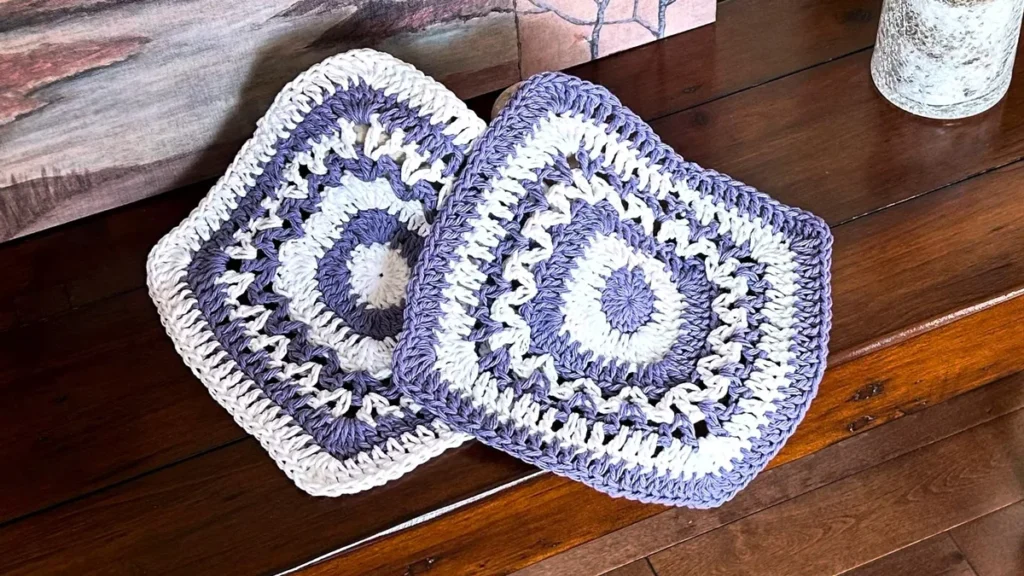
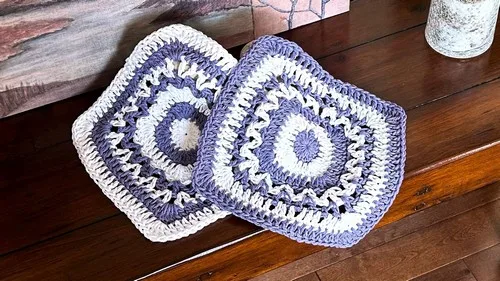
What comes off the hook is a two-color cotton square, Iris giving way from White partway through. It is built for a sink, not a shelf, and that is the appeal. Cotton dries fast, holds its shape, and forgives a slightly wobbly first round.
Worth knowing
The satisfaction is in the corners. Five double crochets into one stitch turns a flat row into a square, and watching that pivot happen four times a round never gets old. The single-chain start is the other hook: sixteen stitches crowded into one point instead of a ring, which feels like cheating until you see it hold. The color join by slip stitch is clean and quick, no fuss with knots mid-row. And the notes about keeping the V-stitch spine aligned round over round give the whole piece a rickrack texture that a plain granny square doesn't have. It is a small project, but it teaches corner math you'll use everywhere else.
Common mistakes
- Miscounting the chain-3 as a stitch Remember the starting chain-3 stands in for a double crochet. Skip it when counting stitches across a row and you'll come up short at the corner.
- Losing track of the first DC Keep the stitch marker on that first double crochet from round one. It's your anchor point for every round after.
- Skipping a corner increase Corners need the full cluster of stitches, not a partial one. Count as you go rather than eyeballing the bump.
- Breaking the V-stitch spine alignment Each new round should sit directly over the spine of the V below it. If it drifts, the rickrack line blurs and the square can pull sideways.
Beginner
Progress Tracker
0 of 0 rounds
Tap a round to tick it off — your place is saved on this device.
The kit
- Loops and Threads Classic Cotton yarn in colors Iris and White
- 5 mm crochet hook
- Stitch marker (a bobby pin works well)
- Yarn needle, for weaving in ends
Create a Slip Knot
Wrap yarn around your finger, cross it over, go under the first loop, and pull up the second loop to form the knot.
Chain 4: Yarn over and pull through the loop on your hook, repeat for a total of four chains.
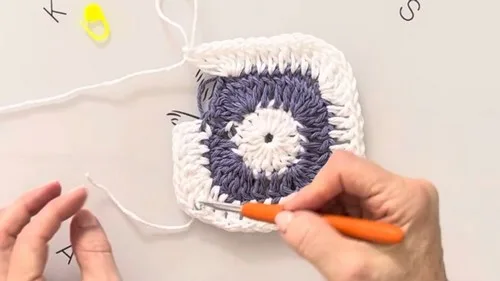
Row 1First Double Crochet (DC) Stitches: Yarn over, insert into the first chain, and perform a double crochet. Continue making 15 more DCs into the same stitch, placing a stitch marker on the first DC for easier counting.(16)
Joining a New Color
Switch to Iris Yarn: Cut the white yarn, pull through and tie off.
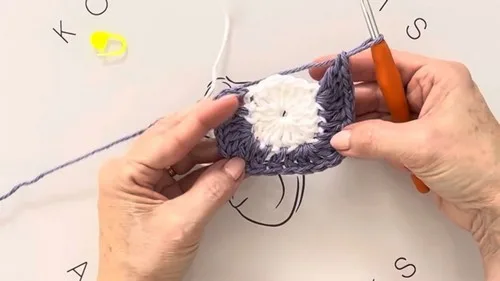
Attach Iris yarn with a slip stitch into the top of the third chain from the last row.
Row 2Begin Expansion: Chain 3 (counts as first DC). DC into the next stitch. Make 5 DCs into the next stitch (forming a corner), then DC in each of the next three stitches.Repeat from to around, ensuring you create corners and flat sides.
Row 3Building Shape: Continue the expand pattern, with each flat side increasing by one DC between corners.Rickrack V-Stitch Pattern, Initiating Rickrack V-Stitch: chain 4 after connecting the new row (counts as DC plus chain space); in the same space, add a DC to complete the first V-stitch; skip two stitches, and make a V-stitch (DC, chain 1, DC) in the next; continue the pattern around, finishing at the starting V-stitch.
Subsequent Rows
Rows 4+Continuing Pattern: Alternate colors as needed or desired, following the V-stitch pattern around the squares, and increasing the number of stitches as the dishcloth expands.
Every new row in V-stitch will align with the 'spine' of the V from the previous round to keep the rickrack appearance.
From the collection
Finishing
- Finish with a Slip Stitch: Once desired size is achieved, slip stitch to join the end of the row to the beginning. Cut the yarn and weave in the ends using a yarn needle.
- Weave in the cut end of the white yarn and the tail from the Iris join along the wrong side.
- Optionally, block the finished dishcloth to give it a professional finish and even out the stitching.
- Trim any remaining tails close to the fabric so they don't catch on dishes.
Why it works
The piece begins with sixteen double crochets worked into a single chain rather than a ring, which acts as the square's spine.
Corners are built with a five-double-crochet increase into one stitch, while flat sides gain one extra double crochet per round to keep the square true.
The color join lands with a slip stitch into the top of the third chain from the previous row, anchoring Iris exactly where the turning chain left off.
What it becomes
- A everyday dish scrubber, paired with a bar of soap by the sink.
- A quick handmade gift, bundled with a second cloth in a different color run.
- A trivet stand-in under a warm mug, paired with a matching coaster from the same cotton.
Original pattern: https://crocheteverything.com/crochet-dish-cloth-tutorial-for-beginners-step-by-step/
FAQ
Why sixteen double crochets into one chain instead of a ring?
It's the pattern's chosen start, and it works because cotton yarn holds the crowded stitches in place. I haven't seen the designer explain the choice beyond that, so I won't guess further.
Can I use more than two colors?
The notes say to alternate colors as needed or desired, so yes. Just keep joining with a slip stitch at the same spot each time to stay consistent.
Do I really need a stitch marker?
the first round, yes. Sixteen stitches into one chain is easy to lose count of without one, and a bobby pin works fine.
How do I know when the square is big enough?
The pattern continues the expand rounds for a few more rows after the color join. Stop whenever the size suits your sink or your yarn runs low, then slip stitch the end of the row to the beginning to close it off.