
Free Pattern
Step-by-Step
Crochet
AmigurumiCrochet Jellyfish Amigurumi Pattern: Squishy Ocean Buddy
Make a squishy crochet jellyfish amigurumi with a ruffled skirt and six dangly tentacles. A fun written pattern using basic stitches and plush yarn.
Level IntermediateTime 4-6 HoursHook 8 mmYarn Worsted
Pattern highlights
- Start the body with a magic ring and increase steadily each round to shape a rounded dome.
- Pause partway through to insert the safety eyes evenly spaced apart for a friendly face.
- Stuff the body firmly as you go so the shape stays full and rounded throughout.
- Finish the body's final round, then attach fresh yarn into the unused loops for the skirt.
- Work a ruffled skirt round around that same edge to create the jellyfish's flared hemline.
- Chain and shape six separate tentacles, varying their lengths for a natural, flowing look.
- Leave long yarn tails on each tentacle so they're ready to sew onto the body.
- Sew all six tentacles beneath the body, then embroider a simple smile to finish the face.
About This Pattern
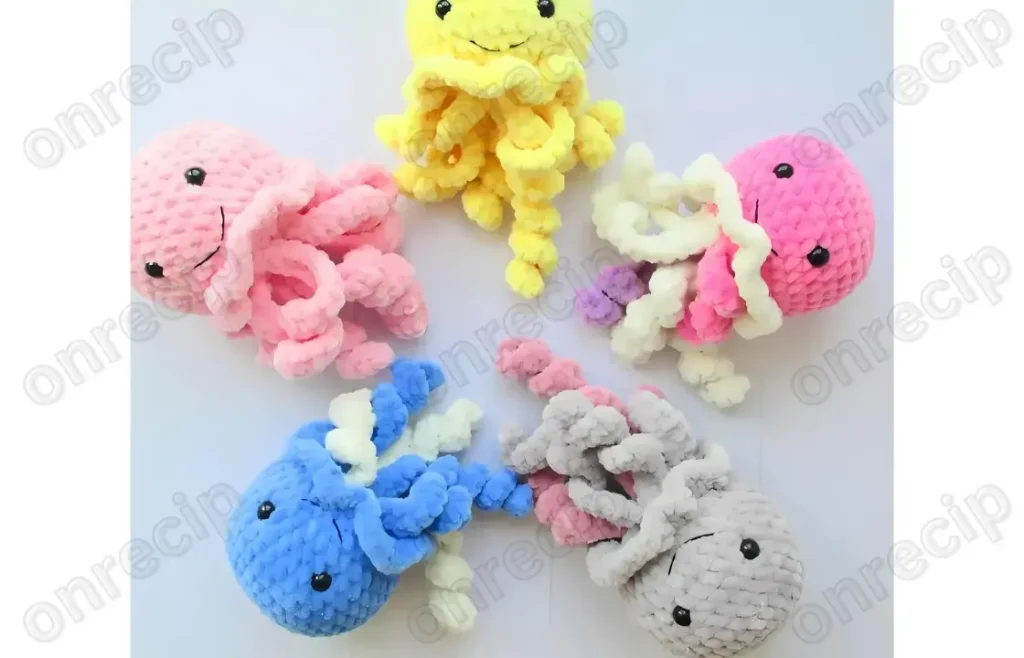
This crochet jellyfish amigurumi turns a simple domed body into an adorable sea creature, complete with a ruffled skirt worked into the front loops and six tentacles that dangle beneath. It's the kind of project that looks far more impressive than the stitch count suggests, making it perfect for anyone who wants a showpiece amigurumi without an overwhelming pattern. Ocean lovers, nursery decorators, and anyone hunting for a unique handmade gift will fall for this squishy little guy.
The body is built with straightforward single crochet increases and decreases worked in continuous rounds, while the skirt introduces the fun front-loop-only technique for a distinct ruffled edge. The tentacles let you play with chain lengths and stitch combinations, so you'll practice both foundation chains and simple shaping. Expect this project to take an evening or two, roughly four to six hours total, with most of that time spent stuffing and shaping the tentacles.
The finished jellyfish is a plush, huggable little sea creature with a rounded body, a ruffled skirt hem, and six soft tentacles trailing beneath — each one embroidered with a sweet, simple smile. Worked up in Himalaya Dolphin Baby plush yarn, it comes out irresistibly soft and squeezable, ideal for a baby's room, a beach-themed shelf, or a thoughtful handmade gift for anyone who loves the ocean.
Variations
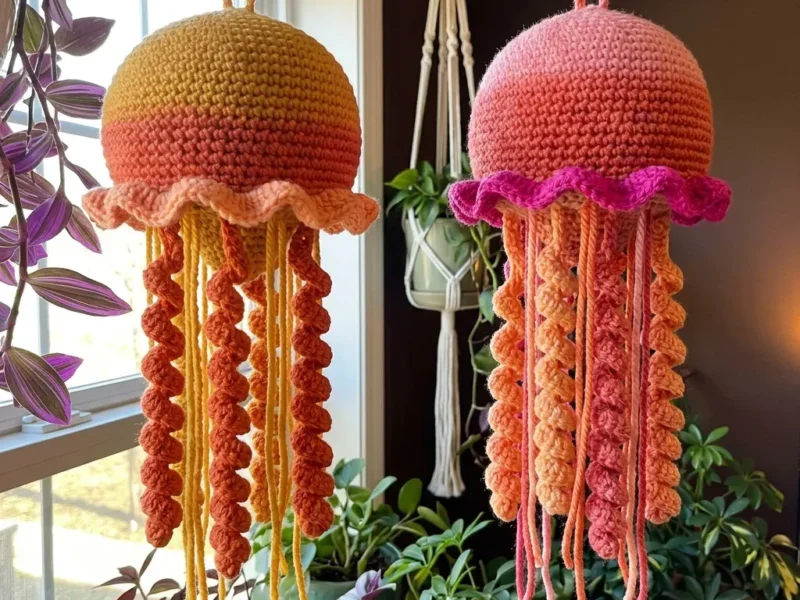
One of my favorite things about this jellyfish is how easy it is to make it your own. Try working the body in a soft lavender or seafoam green Himalaya Dolphin Baby yarn instead of the classic pink or blue, then pair it with tentacles in a contrasting shade like coral or lemon yellow for a candy-colored coral reef look. If you want an ombré effect, work each tentacle in a slightly lighter or darker shade of the same color family so they fade gracefully from the body outward. For a beach-themed nursery mobile, make three or four mini jellyfish using a thinner yarn and a smaller 3mm hook, keeping the tentacle chains shorter so they stay proportional. You could also mix and match all six tentacle styles from the pattern in a single jellyfish for a wild, curly-and-straight combination that looks especially playful. If you're after a bigger cuddle buddy, size up to a bulky weight yarn and a 5.5mm hook, adding a round or two to the body before the skirt to keep proportions balanced — just remember this will use noticeably more yarn than the stated 1/3 skein. Sparkly or glow-in-the-dark yarn blended with a strand of the plush yarn can give the tentacles a magical, bioluminescent feel for an under-the-sea display piece. For gifting, consider embroidering the smile in a bright contrasting thread, or skip the smile altogether and add a tiny bow at the top of the skirt for a girlier version. However you customize it, this pattern's simple shapes make it endlessly adaptable to whatever color story or size you're dreaming up.
I adore this pattern because it takes one of the simplest amigurumi shapes — a basic domed body — and dresses it up with details that make it feel special. The front-loop-only skirt round is such a satisfying trick; you attach fresh yarn into round 14's front loops while the back loops are already used, and suddenly you've got a ruffled hem that looks way more advanced than it actually is. Then there are the tentacles — six of them, each worked from a different chain length so no two are identical, which makes the whole piece feel organic and a little whimsical instead of stiff and uniform. Inserting the 8mm safety eyes between rounds 9 and 10 and spacing them exactly 6 SC apart gives the face such a sweet, alert expression before you've even added the smile. And stitching that little embroidered smile at the very end, following the simple insert-and-loop technique, is the moment this project truly comes alive in your hands. It's a small pattern with a big personality, and I genuinely smile every time I finish one.
Common mistakes
- Losing track of stitch counts
- Use a stitch marker at the start of each round and count your stitches before moving to the next round, especially through rounds 2-5 where increases happen every stitch or two.
- Working the skirt into the wrong loop of round 14.
- Since round 14 was worked in back loops only, double-check you're attaching your new yarn and working the skirt's double crochets into the remaining front loops, not accidentally into the same back loops again.
- Under-stuffing the body before closing it up.
- Stuff firmly and consistently as you go rather than waiting until the end — the pattern specifically calls for firm stuffing, and adding it gradually helps the jellyfish hold its rounded shape.
- Placing the safety eyes too close
- Insert the eyes between rounds 9 and 10 and measure carefully so they sit exactly 6 SC apart for a balanced, friendly-looking face.
- Making all six tentacles identical
- Follow the different chain lengths and stitch patterns for each tentacle as given — the variation in length and curl is what gives the jellyfish its natural, flowing look.
- Trimming tentacle tails too short before sewing them on.
- Leave a 20-25 cm tail on each tentacle as instructed; a longer tail gives you plenty of length to securely sew each one to the underside of the body.
Intermediate
Progress Tracker
0 of 0 rounds
Tap a round to tick it off — your place is saved on this device.
Materials
- Diameter of the toy (with tentacles included): _ cm (inches)
- 8 mm safety eyes
- Hook size: 4 mm
- Yarn consumption for one jellyfish: approximately 1/3 skein of plush yarn, Himalaya Dolphin Baby
- Stuffing (holofiber or synthetic stuffing)
Body
- Round 17 SC into MR. (7)
- Round 2INC in each stitch. (14)
- Round 3(1 SC, INC) x7. (21)
- Round 4(2 SC, INC) x7. (28)
- Round 5(3 SC, INC) x7. (35)
- Round 6-1235 SC. (35)Insert eyes between rounds 9 and 10, 6 SC apart.
- Round 13(3 SC, DEC) x7. (28)Stuff the body as you go.
- Round 14(2 SC, DEC) x7 — crochet in back loops only for this round. (21)
- Round 15(1 SC, DEC) x7. (14)
- Round 167 SC. (7)Stuff the body firmly.Leave a 30 cm yarn tail and sew the opening shut. Fasten and hide the yarn.
Skirt
Attach yarn in round 14 of the body, which was worked in back loops. The skirt will be worked in the front loops of round 14.
- Round 1Ch 2, in each front loop of round 14 work 2 DC, join the last and first DC with a SL ST. (42 DC)Fasten and hide the yarn.
Tentacles
Make 6You can make 6 different types of tentacles, varying the chain length and stitch pattern for different lengths and curliness.
You can make different types like shown, or stick to just one or two — it's up to you.
- Tentacle 1Tentacle 1 - Round 1: Chain 15, starting from the second chain from the hook, work (1 SC, INC) x6, 2 SC. (20)Leave a tail of about 20-25 cm on each tentacle for sewing onto the body.
- Tentacle 2Tentacle 2 - Round 1: Chain 20, starting from the second chain from the hook, work (2 SC, INC) x6, 1 SC. (25)
- Tentacle 3Tentacle 3 - Round 1: Chain 30, starting from the second chain from the hook, work (2 SC, INC) x9, 2 SC. (38)
- Tentacle 4Tentacle 4 - Round 1: Chain 20, work 1 SC in each chain. (19)
- Tentacle 5Tentacle 5 - Round 1: Chain 23, work 1 SC in each chain. (22)
- Tentacle 6Tentacle 6 - Round 1: Chain 25, work 1 SC in each chain. (24)
Assembly
- Step 1Sew the tentacles to the underside of the body.
- Step 2Smile Embroidery: Insert the needle at point 1 and bring it out at point 2. Pull the thread through.
- Step 3Then insert the needle at point 3 and bring it back out at point 1.
- Step 4The thread between points 2 and 3 should go under the thread at point 1. Tie a knot at point 1 to secure the smile. Hide the thread ends inside the toy.
Important notes
Work with Himalaya Dolphin Baby plush yarn and a 4mm hook for the softest, most huggable texture — roughly 1/3 of a skein makes one jellyfish, so a single skein can yield a few color variations.
Keep your tension fairly tight throughout the body so stuffing doesn't peek through between stitches, which is especially important with a fluffy plush yarn.
Mark the start of every round with a stitch marker, since the body is worked in continuous rounds without joining, making it easy to lose your place otherwise.
When attaching yarn for the skirt, make sure it's securely anchored in the front loops of round 14 before working your first chain 2, so the ruffle doesn't come loose later.
Take your time with the smile embroidery at the end — insert at point 1, out at point 2, back in at point 3, and out at point 1 again, letting the thread between points 2 and 3 tuck under point 1 before tying off.
Arrange all six finished tentacles under the body before sewing to plan their spacing evenly, which makes the jellyfish look balanced and full once attached.
Author: @Victoria_Hobby / translated by onrecip.
You can use leftover yarn in different colors for this project.
Original pattern: https://onrecip.com/free-jellyfish-amigurumi-crochet-pattern/
FAQ
What yarn works best for this jellyfish amigurumi?
Himalaya Dolphin Baby plush yarn with a 4mm hook is recommended for its soft, velvety texture, and about 1/3 of a skein is enough for one jellyfish. Any plush or velvet-style yarn in a similar weight should work as a substitute.
Why does the skirt use front loops when the body used back loops?
Working the body's round 14 in back loops only leaves the front loops free and unused, so when you attach new yarn there for the skirt, you get a distinct ridge that makes the ruffled edge pop visually.
Do all six tentacles need to be different?
No, the varied chain lengths and stitch patterns are simply a suggestion to add natural-looking variety, but you can absolutely repeat one or two favorite tentacle styles for all six if you prefer a more uniform look.
How do I keep the safety eyes positioned correctly?
Insert them between rounds 9 and 10 of the body, spacing them 6 SC apart around the circumference, and it helps to test-fit them without securing the backs first to check the placement looks even.
What stuffing should I use for the firmest shape?
Holofiber or synthetic stuffing both work well, and stuffing firmly as you crochet each round of the body — rather than only at the end — gives the finished jellyfish a rounder, sturdier shape.