Free Pattern
Step-by-Step
Crochet
Motifs & AppliquesEasy Floral Hexagon Crochet Pattern for Beginners
Learn to crochet a colorful floral hexagon with this easy beginner pattern using clusters, chain arches, and layered petals for a pretty finished motif.
Level BeginnerTime 1-2 HoursHook 2 mmYarn Sport
Pattern highlights
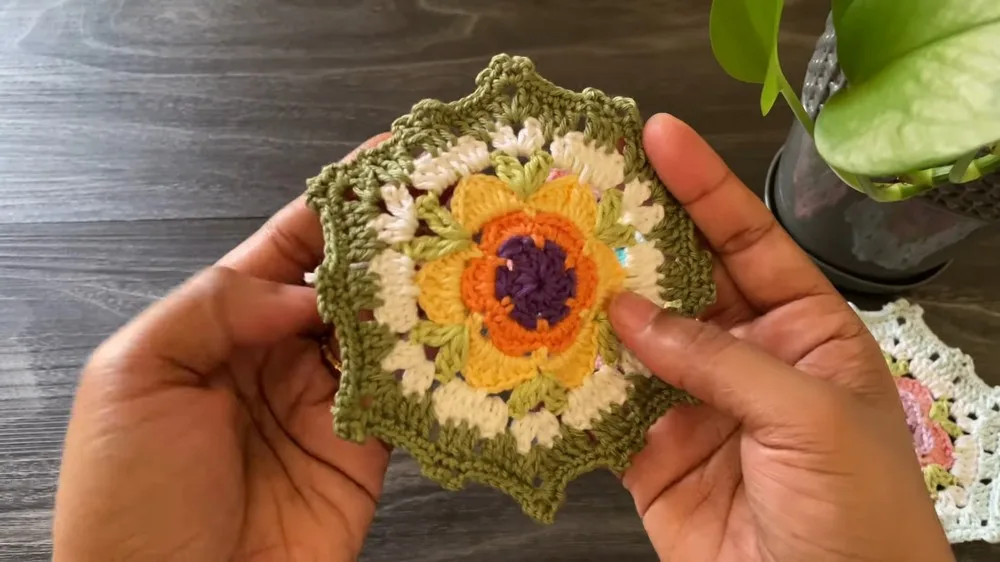
- Start with dark purple yarn and form a ring, then build six double crochet clusters around it separated by small chain gaps.
- Join the final cluster with a slip stitch to close the round neatly, then cut the yarn and set it aside.
- Chain loosely to form arch shapes, securing each one with a single crochet worked between the clusters below.
- Continue around until six arches frame the flower center, then join and cut the orange yarn.
- Work single, half-double, and double crochet into each arch to build the first row of petals, then join and cut the yarn.
- Work single, half-double, double, and treble crochet into each large loop to create layered, extended petals, then cut the yarn.
- Return to green yarn and add scallop details around the corners and edges with chains and single crochets to finish the border.
- Weave in every tail and give the hexagon a light block so it lies flat.
About This Pattern
This Easy Floral Hexagon is a sweet little motif that starts as a simple ring of double crochet clusters and blooms into a layered flower sitting inside a six-sided frame. It's the kind of pattern that looks far more impressive than the effort it actually takes, which makes it perfect for beginners who want a confidence-boosting win, and for scrap-yarn hoarders looking for the ideal project to finally use up all those pretty sport-weight leftovers sitting in the stash bin.
You'll work with several simple building blocks here: clusters of double crochet worked into a starting ring, open chain arches connected with single crochets, layered petals combining single, half-double, double, and treble crochet, a ring of leaf clusters, and a scalloped border worked in rounds. None of these techniques are difficult on their own, but stacking them together teaches you how texture and shape build up round by round. Expect this hexagon to come together in about an hour or two once you're comfortable with the rhythm.
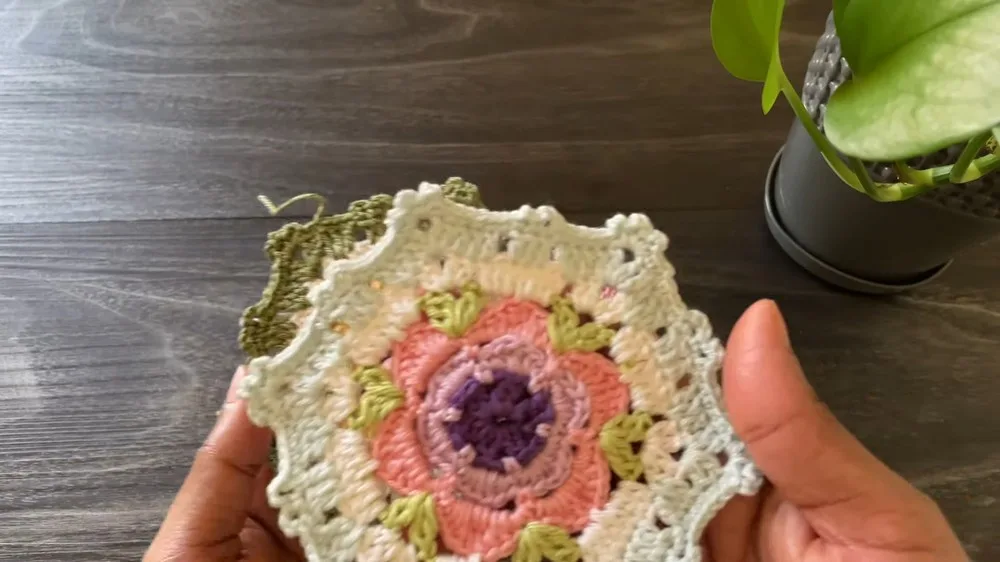
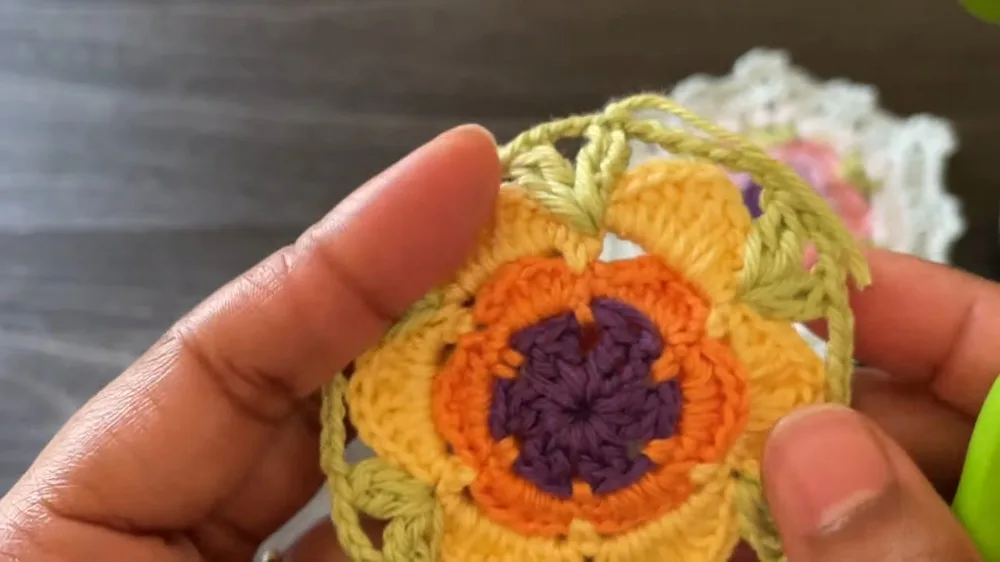
The finished hexagon is a compact, richly textured motif with a raised, layered flower centered inside six flat sides framed by a scalloped border, ready to be joined into a blanket, framed as a coaster, or stitched onto a bag. Made in dark purple, orange, yellow, green, and white as shown, or in any color combo you love, it has that handmade charm that makes people ask where you bought it. Stitch up a few and you've got the start of a gorgeous gift.
Variations
This hexagon is a color-lover's playground, so don't be afraid to experiment. Try a sunset palette with coral for the clusters and golden yellow for the petals, or go moody with deep teal clusters and dusty rose petals for an autumn-inspired motif. For a classic garden look, keep the clusters in green (mimicking a leafy base) and let the petals shine in pink, lavender, or cream. Since the pattern already calls for six colors of sport-weight cotton, this is a wonderful stash-buster—grab your prettiest sport-weight cotton like 24/7 Cotton, Paintbox Yarns Cotton DK, or Scheepjes Catona in coordinating shades and let each round be a new color. If you want a bigger hexagon, work an additional round of double crochet clusters or single crochet around the outer edge after the scalloped border, adding stitches evenly to keep the sides flat. For a smaller, dainty version, drop down to a 1.75mm or 1.5mm hook with fine crochet cotton for delicate motifs perfect for earrings or bookmarks. You can also swap the petal stitch sequence for all double crochet if you want fuller, rounder petals instead of the pointed look created by the single-half-double-double-treble combination. Themed variations are easy too—work the clusters in white and petals in red and green for a festive floral, or use pastel yarns for a spring garland strung together with chain stitches. Joining multiple hexagons edge to edge (matching up chain-2 spaces) turns this into a full blanket, table runner, or wall hanging in no time, and mixing your color palette hexagon to hexagon creates a beautifully scrappy, cohesive look.
Common mistakes
- Clusters coming out uneven or twisted
- Pull your starting ring closed firmly before working the first cluster, and count your six clusters as you go, placing a stitch marker after the third one to make sure you're staying evenly spaced.
- Losing track of which chain-2 space
- Before cutting the dark purple yarn, mark the final chain-2 space with a scrap of contrasting yarn or a stitch marker so you know exactly where to reattach for round two.
- Chain arches ending up too tight
- Keep your chain stitches relaxed but consistent—try laying the chain flat against your work as you go to check it matches the length of previous arches before securing with a single crochet.
- Single crochets between clusters
- Always anchor your single crochet directly into the top of the cluster from the previous round, not into the chain space itself, to keep the arches sitting flat and symmetrical.
- Petals looking flat instead of curved
- Double check you're working single crochet, then half-double crochet, then double crochet (and treble crochet for the layered petal round) stitches in that exact rising sequence into each loop—the increasing stitch height is what creates the curved petal shape.
- Yarn tails left long and messy after each color change.
- Leave a 4-6 inch tail whenever you cut yarn between rounds, then weave in ends immediately after finishing so your hexagon stays neat and tangle-free while you work.

Beginner
Progress Tracker
0 of 0 rounds
Tap a round to tick it off — your place is saved on this device.
Materials
- Six colors of sport-weight cotton yarn.
- A 2mm crochet hook.
Main Pattern
- Round 1Creating the Center Begin with a dark purple yarn . Create a slip knot and work a starting ring. Form six clusters of double crochets around the ring, separated by chain stitches.Complete the first row by joining the last cluster with a slip stitch, cut the yarn, and set it aside.
- Round 2Adding Chain Arches Switch to orange yarn and attach it to a chain-2 space from the previous row.Create arches by working chain loops, connecting each arch with single crochets between clusters.Complete this row by joining the last loop and cutting the yarn.
- Round 3Forming Petals Work petals into each chain loop using single, half-double, and double crochets in a sequence.Finish the row by joining the last petal and cutting the yarn.
Each petal is shaped to give dimension and texture to the design.
- Round 4Adding Foundation for Large Arches Use yellow yarn to create larger loops (chain 8) between petals.Attach the yarn in the spaces between petals and repeat the chain-loop process.These loops create the structure for the next set of decorative details.
- Round 5Crafting Layered Petals Work a sequence of single, half-double, double, and treble crochets into each large loop to form layered, extended petals.Repeat the same petal format around the hexagon for consistency.Complete the row by cutting off the yarn after securing the final petal.
- Round 6Adding Leaf Motif Switch to green yarn to add a leaf pattern. In the spaces between petals, work double crochet clusters separated by chains.
This gives the appearance of leaves encircling the floral motif.
- Round 7Creating the Border Base Use white yarn to begin defining the hexagon border. Create corner spaces with double crochets and chains.In the other sections, work a sequence of double crochets that frame the piece neatly.
- Round 8Adding Final Border with Scallops Return to green yarn to create the finishing touches. Add scallop details to the corners and edges with chains and single crochets.
The scallops provide a decorative and polished border.
Important notes
💡 Use a 2mm hook consistently throughout, since sport-weight cotton worked at this gauge is what gives the hexagon its crisp, defined stitch definition.
💡 Place a stitch marker in the first stitch of each new round so you always know exactly where to rejoin with your slip stitch.
💡 Block your finished hexagons lightly with steam or a quick spritz of water to help the petals lie flat and the sides of the hexagon stay crisp and even.
💡 If you plan to make several hexagons for a blanket, keep a consistent tension by using the same brand of sport-weight cotton for every motif.
💡 Save your cut yarn tails from color changes—short scraps are perfect for whip-stitching hexagons together later without needing to start a whole new ball.
More photos
FAQ
What yarn weight works best for this floral hexagon?
Sport-weight cotton is ideal, as the pattern is designed around it and gives the clusters and petals nice stitch definition. A light DK weight can work too, just size your hook up slightly if your gauge feels tight.
Can I use just two colors instead of six?
Absolutely—while the pattern uses six colors for a vibrant look, you can easily work the whole hexagon in one or two colors for a more subtle, monochrome effect. Just follow the same color-change points if you want to keep some contrast between the clusters, arches, petals, leaves, and border.
How big is the finished hexagon?
Using a 2mm hook and sport-weight cotton, expect a compact motif a few inches across, ideal for coasters, appliques, or joining into a larger blanket. Exact size will vary slightly depending on your tension.
Is this pattern really beginner-friendly?
Yes—the techniques involved are basic double crochet clusters, chain stitches, single crochet, half-double crochet, treble crochet, and slip stitch joins, all worked in a repeatable sequence. If you know these fundamental stitches, you'll be able to complete the hexagon confidently.
Can I join multiple hexagons together to make a blanket?
Definitely—this hexagon shape is perfect for joining edge to edge through the chain-2 spaces or scalloped border using slip stitch or single crochet seams. Mixing color combinations across several hexagons creates a beautiful, scrappy floral blanket.