Free Pattern
Step-by-Step
Crochet
GarmentsOversized textured cluster crochet sweater in warm neutrals
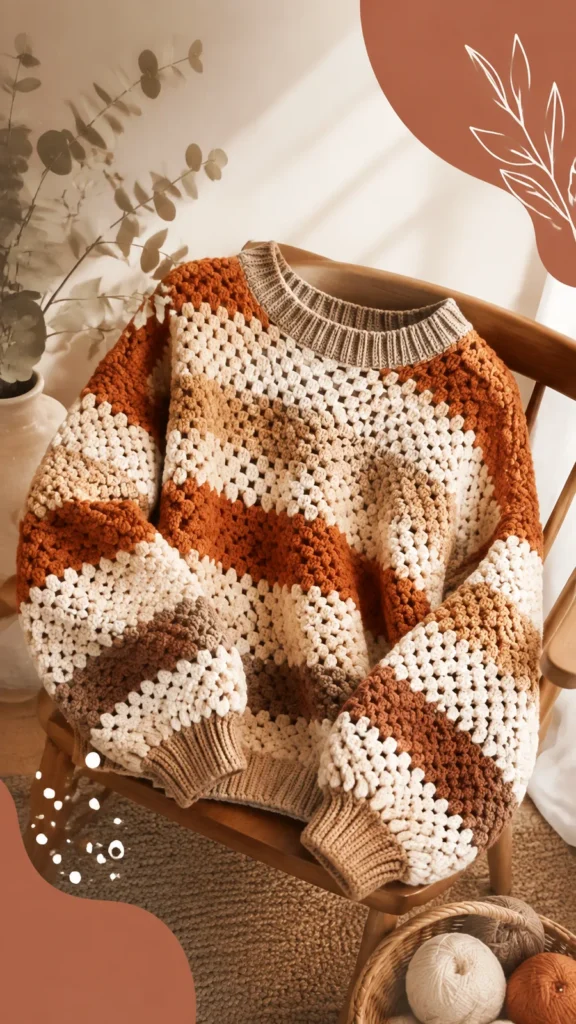
An oversized crochet sweater with textured clusters, worked flat in warm neutral panels.
- Level
- Intermediate
- Time
- 4-6 hours
- Hook
- 5 mm
- Yarn
- Worsted
Pattern highlights
- Crochet the front panel flat from the bottom edge, alternating plain rows with textured cluster rows.
- Repeat the same row pattern for the back panel so both pieces match in height and texture.
- Work each sleeve separately as a flat piece using the same single crochet and cluster sequence.
- Join the front and back panels at the shoulders to establish the dropped-shoulder shape.
- Attach the sleeves along the armhole edges after the shoulder seams are set.
- Seam the side and sleeve edges to close the sweater into its finished silhouette.
- Block all pieces before or after assembly so the stripes and texture sit evenly.
About This Pattern
Every notebook needs a garment entry eventually, and this sweater earns its page. It sits apart from the amigurumi and coasters I usually log, in the slower, bigger-commitment section. A front panel, a back panel, two sleeves — nothing fussy, just four honest pieces waiting to be joined.
The technique worth noting is the textured cluster, built from paired double crochets with a chain between them. It alternates with plain single crochet rows, so the fabric breathes between bursts of texture. I like that the cluster has a name and a job, not just a pretty picture.
What comes out the other end is a roomy pullover, dropped shoulders and all, in warm brown, cream, and taupe. It reads handmade without trying too hard. The kind of sweater you reach for before you've decided what else you're wearing.
Worth knowing
I like a project that teaches one new move and lets me use it on repeat. The textured cluster — two dc, a chain, two dc, skip a stitch, again — turns plain rows into something with shadow and lift. It's simple enough to memorize by the second row. Working the panels flat means I can see the whole stripe sequence laid out on my lap, no guessing how it will look joined. And an oversized pullover forgives a lot; dropped shoulders mean I'm not chasing precise armhole math. By the time the sleeves go on, the cluster rhythm feels automatic, which is its own small reward.
Common mistakes
- Losing the cluster's skipped stitch The textured cluster asks you to skip a stitch after each 2 dc, ch 1, 2 dc group. Miss that skip and the row count drifts, so count stitches at the end of every cluster row.
- Uneven turning chains between row types Single crochet rows and double crochet rows use different turning chains in this pattern. Check which chain height a row calls for before turning, not after.
- Sleeves crocheted to mismatched row counts Both sleeves should follow the same row sequence so they hang evenly. Lay them side by side before attaching to catch any difference early.
- Skipping blocking before seaming Cluster texture looks lumpy until it's blocked flat. Wet and reshape each panel to its intended measurements before joining seams.
- Stretching seams at the shoulder A dropped-shoulder join needs a relaxed, even seam, not a tight one. Pin the front and back panels together before sewing so the seam doesn't pull the fabric.
Intermediate
Progress Tracker
0 of 0 rounds
Tap a round to tick it off — your place is saved on this device.
The kit
Color A
- Warm brown, approximately 700 yards (640 meters)
Color B
- Cream, approximately 650 yards (594 meters)
Color C
- Soft beige or taupe, approximately 450 yards (412 meters)
- 5 mm US H-8 crochet hook
- Yarn needle
- Scissors
- Stitch markers
- Measuring tape
Front Panel
With Color A, ch 89.
Round 1Sc in second ch from hook and across. Turn. (88 sts)
Round 2Ch 1, sc across. Turn. (88 sts)
Round 3Ch 2, dc across. Turn. (88 sts)
Round 4Ch 1, sc across. Turn. (88 sts)
Round 5Ch 2, work textured clusters across, placing one cluster every 3 stitches. End with dc in last stitch. Turn.
Round 6Ch 1, sc across. Turn. Repeat Rows 3 through 6 until the panel measures approximately 22 inches (56 cm) from the starting edge. Change colors every 6 rows following the sequence: Color A, Color B, Color C, Color B, Color A.
Sleeves
With Color A, ch 45.
Round 1Sc in second ch from hook and across. Turn. (44 sts)
Round 2Ch 1, sc across. Turn.
Round 3Ch 2, dc across. Turn.
Round 4Ch 1, sc across. Turn.Row 5: Work textured clusters across row.
Round 6Sc across. Repeat Rows 3 through 6 until sleeve measures approximately 18 inches (46 cm). Make two identical sleeves.
Special Stitch
Textured Cluster: In the same stitch space, work 2 dc, ch 1, and 2 dc. This creates a raised cluster texture. Skip the next stitch before working the following cluster.
Back Panel
Make one back panel following the exact same instructions as the front panel.
Assembly
Step 1Blocking helps relax the stitches and creates a more polished garment shape. Lightly wet the sweater pieces, reshape them according to measurements, and allow them to dry completely before assembly.
Step 2For long-lasting wear, follow the yarn care instructions. Many handmade crochet sweaters benefit from gentle washing, careful reshaping, and air drying.
Finishing
- Weave in every yarn end from color changes along the panel and sleeve edges before seaming.
- Block the front panel, back panel, and both sleeves to relax the cluster texture and even the stripes.
- Seam the shoulders first, then attach the sleeves and close the side and sleeve edges.
Why it works
The front panel starts with a foundation chain and builds upward in flat rows, which is why there's no shaping until the shoulder seam decides the silhouette.
Rows alternate between plain single crochet and the textured cluster, so every raised row sits between two calmer rows that keep the stitch count steady.
Working the sleeves as separate flat panels, rather than in the round, keeps the hook work identical to the body and simplifies the final seaming.
What it becomes
- An everyday layer over a plain tee with jeans, since the oversized shape does the styling work for you.
- A cozy topper over leggings for casual errands, where the dropped shoulders allow easy movement.
- A textured piece to wear over a skirt for a dressier-but-still-handmade look.
Original pattern: https://duniarecipe.com/cozy-crochet-sweater-aesthetic-ideas-oversized-handmade-knits/
FAQ
Can I make the sweater in a single color instead of stripes?
Yes, the row structure doesn't depend on the color changes. Just swap in your main color wherever the pattern calls for a new shade.
Why are the panels worked flat instead of in the round?
Flat panels let the front, back, and sleeves use identical rows, which keeps the cluster pattern consistent across every piece. It also makes seaming the dropped shoulders straightforward.
Is the textured cluster stitch difficult to learn?
It's a repeated group: 2 dc, a chain, and 2 dc into the same space, then skip a stitch. Once you've worked it twice, the rhythm holds.
How much yarn should I have on hand before starting?
The pattern lists roughly 700 yards of warm brown, 650 yards of cream, and 450 yards of soft beige or taupe. Buy slightly more if your gauge runs loose.