
Free Pattern
Step-by-Step
Crochet
Shawls & WrapsSpider Motif Lace Shawl Worked Join-As-You-Go
A modular spider motif shawl joined as you go, worked in angora for a lacy, seamless finish.
- Level
- Intermediate
- Time
- 4-6 hours
- Hook
- 13 mm
- Yarn
- Lightweight
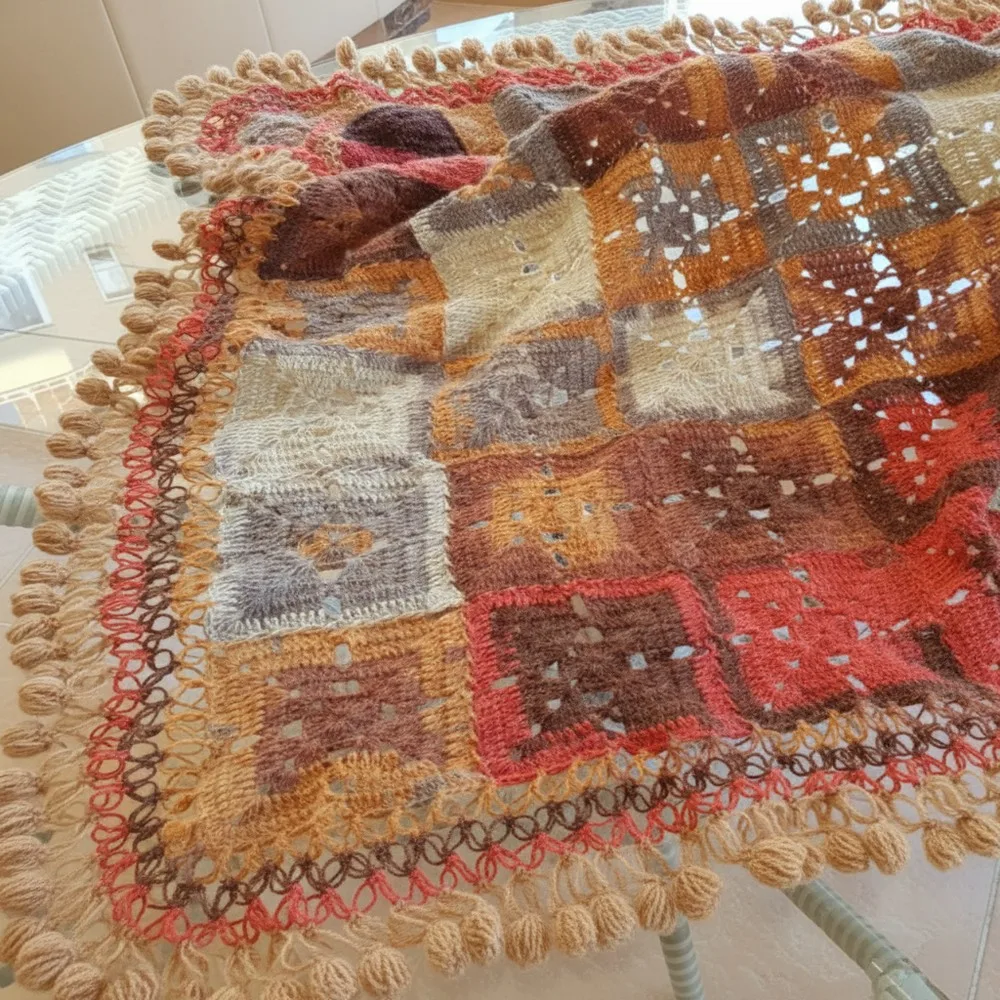
Pattern highlights
- Start each spider motif with a center loop, then work four dc groups separated by ch-3 corners.
- Turn and build outward in rounds, treating each ch-3 as a stand-in for the first dc.
- Join new motifs to previous ones as you work later rounds, rather than sewing pieces together afterward.
- Repeat the motif and joining process across the full set of rounds until the shawl reaches its size.
- Weave in ends as you finish each motif so none pile up for later.
- Add an optional edging, such as sc, hdc, or a spider web border, once all motifs are joined.
- Block the finished shawl to open the lace and square off the points.
About This Pattern
I keep a shelf for motif work, and this shawl earns its spot. It is not a single sprawling piece but a cluster of spider motifs, joined as they grow. That makes it a good middle project — bigger than a coaster, smaller than a full blanket commitment. I like a pattern that lets me stop between motifs without losing my place.
The technique here is join-as-you-go, which I trust more than a pile of seams at the end. Each motif starts in the round from a center loop, builds its dc groups and ch-3 corners, then locks onto its neighbor mid-round. No separate seaming session. No tapestry needle marathon after the fact, beyond the usual ends.
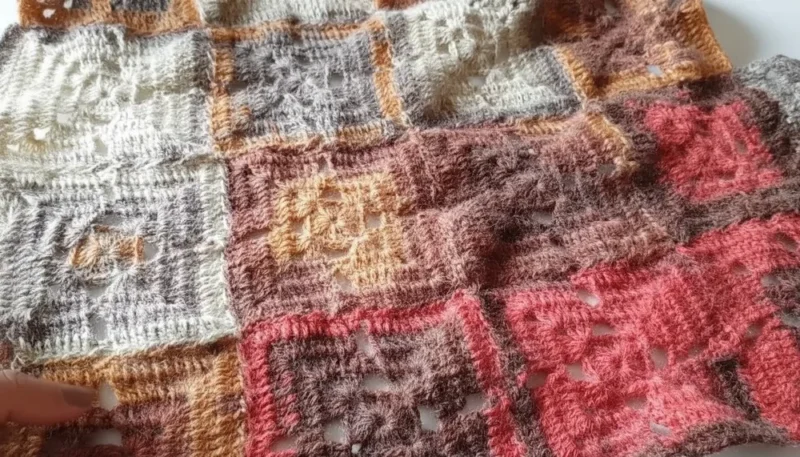
What comes out the other side is a shawl with real drape and open lace, thanks to the angora or mohair-blend yarn the pattern calls for. The spider motifs give it a webbed, dramatic look rather than a dense granny-square feel. It reads as delicate but holds its shape once blocked.
Gauge is not critical for this pattern — looser tension gives an airier, more open fabric, so feel free to adjust your hook size to the drape you want. Motifs are worked in the round, the starting ch-3 counts as the first dc of the round, and you may begin each motif with a magic ring instead of a chain loop if you prefer.
Worth knowing
There is a particular satisfaction in watching a spider motif open up from six stitches into four full dc groups by the end of round one. I like that the corners are built in from the start, not fudged in later — ch-3 corners doing double duty as both structure and lace. Working join-as-you-go also means I avoid the part of motif crochet I dislike most: sewing dozens of squares together at the end. Each new motif clicks into its neighbor as I go, so the shawl grows as one connected piece almost from the start. And because the whole thing is adaptable in scale, I can make the motifs bigger or smaller and still trust the geometry to hold.
Common mistakes
- Forgetting the ch-3 counts as a stitch Treat the starting ch-3 as your first dc every round, or your stitch groups will fall out of alignment. Check your corner count if the motif looks lopsided.
- Skipping the turn between rounds Round 2 specifically calls for a turn — miss it and the join-as-you-go seams won't line up right. Turn, then chain for the corner.
- Joining motifs at the wrong round Join-as-you-go only works if you connect during the later rounds, not the center. Keep the earlier rounds motif-only, then link as instructed.
- Using too heavy a yarn This lace effect depends on a soft, lightweight fiber like angora or a mohair blend. A worsted-weight substitute will stiffen the drape and hide the openwork.
- Blocking too lightly Lace motifs like this need real stretching to open the ch-3 spaces and square the points. A gentle press won't do it — block with intention.
- Joining spaces, not stitches When joining motifs, be sure to connect matching stitches, not just spaces, for a flat, neat join. Also avoid working motifs too tightly, or the joins may pucker.
- Using the labeled hook size exactly best drape with angora yarn, use a hook at least 1mm larger than the label recommends. Use stitch markers to mark motif corners and count your dcs and chs each round for even motifs.
Intermediate
Progress Tracker
0 of 0 rounds
Tap a round to tick it off — your place is saved on this device.
The kit
Yarn
- Angora or similar lightweight mohair-blend yarn. Substitute with soft lightweight acrylic or wool for preference.
Hook
- 13 mm (Size P/Q or 5 in some metric systems–adjust to suit yarn and desired drape)
Tools
- Tapestry needle (for weaving in ends and joining motifs if preferred)
- Scissors
- Optional: Stitch markers (to mark corners as you work), blocking pins.
chain
Special Notes: Motif is worked in the round. Ch 3 at start of round counts as first dc. You may start each motif with a magic ring instead of a chain loop. Motifs are joined on the final round using the Join-As-You-Go (JAYGO) method. Increase the number of motifs for a larger shawl.
Round 1Center Ch 6 , join with a sl st to form a loop (or use a magic ring). Ch 3 (counts as dc), 4 dc in loop , ch 3 , 5 dc in loop, ch 3 ; rep from * to * 2 more times.( You should have 4 groups of 5 dc separated by ch-3 corners )Join with a sl st to top of starting ch-3.
Round 2Ch 6 (counts as dc + ch-3 corner), turn. In same corner: ( 3 dc, ch 3, 3 dc ) in space, ch 3 , in next ch-3 sp: (3 dc, ch 3, 3 dc).Continue around, making (3 dc, ch 3, 3 dc) in each corner, ch 3 between corners.For final corner, after last (3 dc), ch 3 , join with sl st to 3rd ch of start ch-6.
Round 3Ch 6, sc in next ch-3 sp , ch 2 . (3 dc, ch 3, 3 dc) in next ch-3 corner , ch 2, sc in next ch-3 sp, ch 2.Rep step 2 at each corner; after final corner, finish with sc in next ch-3 sp, ch 2, join with sl st to 3rd ch of start ch-6.
Round 4Ch 6 , (3 dc, ch 3, 3 dc) in each ch-3 corner, dc in next 6 dc (along each motif side), ch 2, sc in ch-2 spaces between the main clusters for lacy effect.Continue around, join as before.
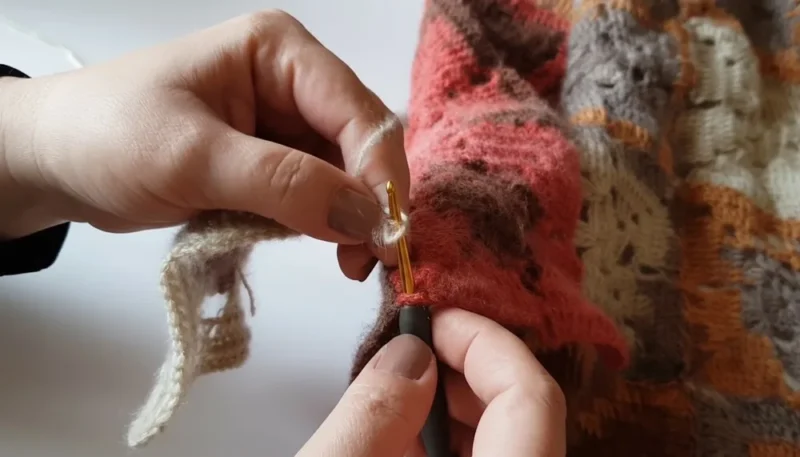
Round 5Final motif/joining round Ch 6. (3 dc, ch 3, 3 dc) in each corner. On each side: dc in each st across (should be increasing by 3 dcs on each row per motif). If joining to another motif, at the 3rd ch of the corner ch-3 sp, connect to the adjacent motif with a sl st instead of ch 3, then continue.Continue around, joining in the corners and sides wherever motifs meet. For open sides, work as normal motif.Join-As-You-Go (JAYGO) MethodOn the final round, work first corner as usual. For the next corner , when reaching the ch-3 sp, insert hook into the corner sp of the motif you want to join, sl st to join, continue with 3 dc in your motif.Along the sides, after every 3 dc, sl st to matching space on the adjacent motif.Continue motif round, joining corners and sides in this manner.Where three or more motifs meet (multi-join), join in the central chain space of all touching motifs.
Half Motif (for shawl edges)
Work partial rounds to fill triangle spaces along shawl top:
Start as for main motif , but only work over two or three sides (half or corner square), increasing at the corners as you would for a full motif.
Join as with full motifs, aligning to fill gaps.
Shawl Construction
For a triangle shawl:
Row 1 Start with 1 motif.
Row 2 Join 2 motifs to previous motif, side by side.
Row 3 Join 3 motifs, and so forth, increasing by 1 motif each row.
Continue until 7 or desired number of motifs in final row for your desired size.
Fill in triangle gaps at the top with half motifs.
Assembly
Step 1Weave in all ends securely with a tapestry needle.
Step 2Optional: Add a border of sc or hdc along the shawl edges for stability or border interest, or work a spider web edging as desired.
Step 3Block shawl gently to open up lace and ensure points.
From the collection
Finishing
- Weave in all ends securely with a tapestry needle as each motif is completed.
- Add an optional border — sc, hdc, or a spider web edging — once every motif is joined.
- Block the shawl gently to open the lace pattern and sharpen the motif points.
Why it works
Round 1 sets the whole motif's geometry: four dc groups of five, separated evenly by ch-3 corners.
The corners in later rounds work (3 dc, ch 3, 3 dc) into each ch-3 space, so increases happen exactly at those four corner points every round.
Turning at the start of round 2 flips the working direction, which is what lets the join-as-you-go connections meet cleanly against neighboring motifs.
What it becomes
- A lightweight wrap for cool evenings, worn over a plain dress or a simple knit top.
- A textural throw for a reading chair, especially paired with solid-color cushions to let the lace show.
- A gift piece for someone who likes handmade accessories with visible, deliberate stitchwork.
FAQ
Can I make this shawl bigger or smaller?
Yes — the pattern notes that motifs are easy to adapt in size. Add or remove rounds per motif, or change how many motifs you join, to scale the whole shawl.
Do I have to use angora yarn?
No, angora or a similar mohair blend is recommended for the lace drape, but the pattern allows substituting a soft lightweight acrylic or wool. Just expect a slightly different hand and openness in the finished lace.
Is the join-as-you-go method hard to learn?
It takes a little attention the first time, but it is really just working stitches into an existing motif's spaces instead of a fresh chain. It saves the separate seaming step entirely.
What size hook does this pattern use?
The pattern calls for a 13 mm hook, roughly a US P/Q or a size 5 in some metric systems. Adjust up or down slightly depending on your yarn and how much drape you want.