Free Pattern
Step-by-Step
Crochet
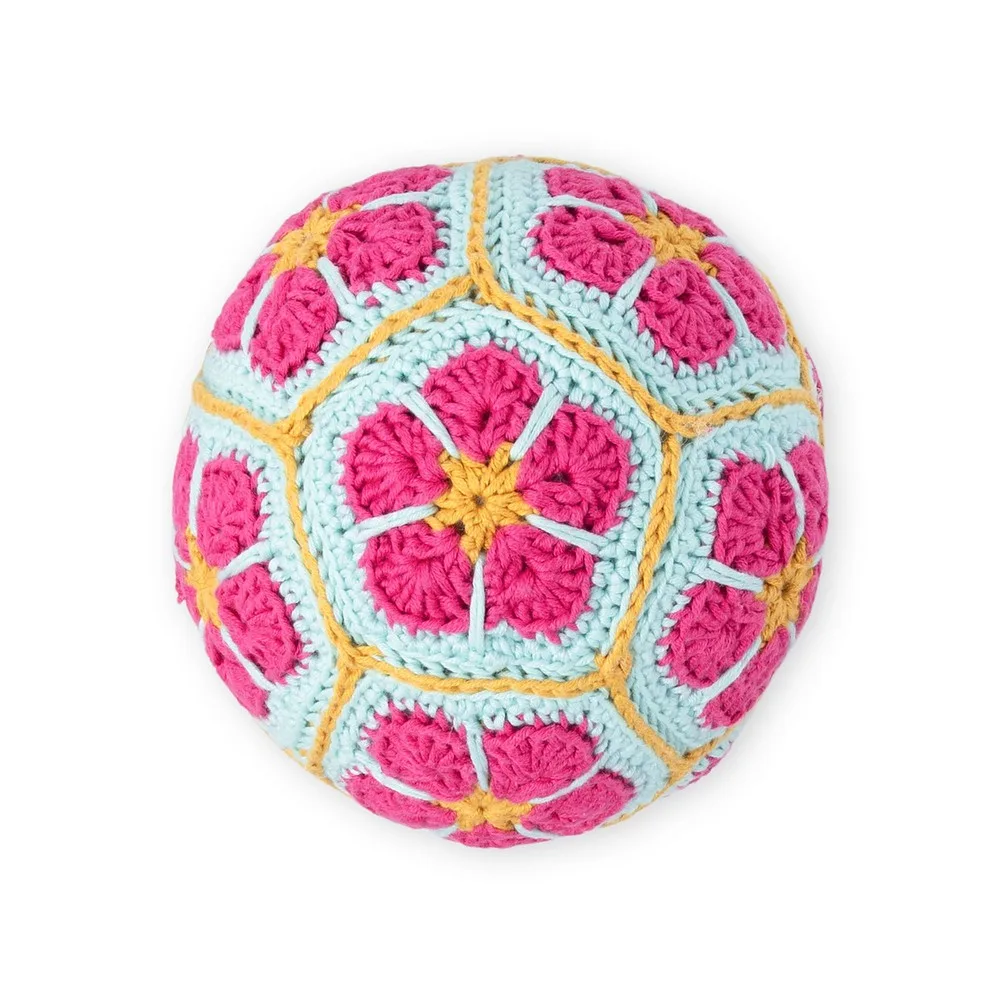
AmigurumiA crochet blossom ball built from twelve joined motifs
A twelve-motif crochet ball with cupped petals, joined and stuffed into a soft sphere.
- Level
- Intermediate
- Time
- 4-6 hours
- Yarn
- Worsted
Pattern highlights
- Start each motif with a tight ring of double crochet, then build outward in two more textured rounds.
- Work the back-loop single crochet round, dipping down to the first ring for the shaping hdc.
- Finish the motif's edge round, adding corner chain spaces that will later meet its neighbors.
- Repeat the whole motif twelve times before any joining or shaping of the ball begins.
- Slip stitch the motifs together through back loops to form two curved half-balls.
- Stuff loosely, then join the two halves with the same flat slip stitch seam.
- Weave in every yarn tail as you go, since color changes happen often.
About This Pattern
This one lives in the drawer I keep for join-as-you-go balls, next to hexipuffs. A ball built from separate motifs is a different kind of patience than a continuous spiral ball. Here you make twelve small flowers first, then marry them into two caps and close the sphere. It rewards a crocheter who likes a stack of finished pieces before assembly begins.
The motif starts as a ring of double crochet, then a round of four-stitch clusters. Those clusters puff outward into five rounded petals. The fourth round is the clever bit, working scbl across petal tops. It also drops three rounds down to tuck an hdc into the center ring. That one stitch anchors the whole flower flat. The fifth round adds corner chains, turning each motif into a joinable hexagon.
Finished, it is a soft sphere about 4¾ inches across. Golden flowers sit edged in fuchsia, with aqua showing through each gap. Twelve motifs make two half-balls that join at the equator. Stuffing goes in before the final seam closes. It reads more like a textile ornament than a toy. Though a child would happily claim it anyway. The palette does the heavy lifting here.
Worth knowing
What I like here is the scbl detail on the fourth round. Working the back loop only, while the front loop stays free, gives ridged texture. Dropping an hdc three rounds below is oddly satisfying to work. It is the stitch that cups the flat motif into a dimensional flower. The fifth round's corner chains turn a plain hexagon into something like a gear. That shape makes the eventual joining seams sit flush. The flat slip stitch join, worked through back loops, keeps the seam tidy. Twelve small, fast motifs beat one long slog.
Common mistakes
- Miscounting the starting ring The ch-4 counts as the first stitch, so the ring totals ten double crochets, not nine.
- Working into stitches, not spaces Round two's clusters go into the spaces between stitch pairs. Working into stitches instead collapses the petal shape.
- Skipping the dropped-down hdc The fourth round's hdc drops three rounds back into the first round. Skip it and the motif stays flat instead of cupped.
- Using both loops for scbl The scbl stitch is back loop only on purpose. Working both loops hides the ridged texture the pattern is going for.
- Joining through both loops Assembly calls for a back-loop-only slip stitch join. Both-loop joining makes a bulky seam instead of the flat ridge detail.

Intermediate
Progress Tracker
0 of 0 rounds
Tap a round to tick it off — your place is saved on this device.
The kit
Yarn
- Bernat® Softee® Cotton™ (4.2 oz/120 g; 254 yds/232 m)
- Contrast A Golden (69013) 1 ball or 70 yds/64 m
- Contrast B Fuchsia (69023) 1 ball or 33 yds/30 m
- Contrast C Aqua Mist (52010) 1 ball or 56 yds/51 m
MOTIF (Make 12)
Starting with A: Ch 4. See diagram on page 2.
Round 19 dc in 4th ch from hook (counts as 10 dc). Join with sl st to top of first dc (top of ch-4). Fasten off.
Round 2Join B with sl st in sp between any 2 dc. Ch 3 (counts as 1 dc). 3 dc in same sp as last sl st.*Skip next 2 dc. 4 dc in next sp between 2-dc. Rep from * to last 2 dc.Join with sl st to top of first ch-3. 20 dc (5 clusters of 4-dc).
Round 3Sl st in each of next 2 sps (ending in sp at center of 4-dc cluster from 2nd rnd). Ch 3 (counts as 1 dc). 6 dc in same sp as last sl st.*Skip next 4 dc. 7 dc in next sp (center of 4-dc cluster from 2nd rnd). Rep from * to last 2 dc.Join with sl st to top of first ch-3. 35 dc (5 clusters of 7-dc). Fasten off.
4th Round
Begin with C:
Round 1Join C with a slip stitch (sl st) in the first double crochet (top of ch-3). Chain 1 (ch 1). Make 1 single crochet (sc) in the same space as the last slip stitch.(1)
Round 2Make 1 single crochet in back loop only (scbl) in each of the next 6 double crochets (dc).(6)
Round 3While working around the 2nd and 3rd rounds, make 1 half double crochet (hdc) in the next space 3 rounds below (1st round).(1)
Round 4*1 scbl in each of the next 7 dc. Working around the 2nd and 3rd rounds, 1 hdc in the next space 3 rounds below. Repeat from * to the last space.(7)
Round 5Join with a sl st to the first sc. You will have 40 stitches in total.
Round 6Note: The hdc in rounds below will cause the Motif to cup. Push double crochet clusters to the right side (RS) to form slightly raised “petals" of flowers.
5th Round
Creating Edges: Chain 1. Make 1 single crochet in each of the first 3 single crochets.
Make (1 sc. Chain 1. 1 sc) in the next single crochet.
*1 single crochet in each of the next 7 stitches. Then, (1 sc. Chain 1. 1 sc) in the next single crochet. Repeat from * to the last 4 stitches.
Finish with 1 single crochet in each of the last 4 stitches. Join with a slip stitch to the first single crochet. Fasten off.
Assembly
Step 1Preparing Half Balls:
Step 2With Color A and the right side facing, slip stitch Motifs together to form 2 halves of the ball as shown in the Assembly Diagram. This should be done through the back loops only, keeping the yarn to the wrong side (WS) to create a flat slip stitch chain detail. See diagram for guidance.
Step 3Assemble the Ball:
Step 4Using Color A and the Flat Slip Stitch Joining method already established, join the 2 halves of the Ball together, inserting stuffing halfway through. Fasten off after joining.
Step 5Note: Make sure to keep the working yarn to the wrong side of the work so that only the flat slip stitch chain is visible on the right side.
Step 6ravelry
Finishing
- Weave in each color's yarn tail on the wrong side as every motif finishes.
- Add stuffing halfway through joining the second half-ball, before that seam closes completely.
- Close the final seam with the same flat slip stitch join, keeping the ridge inside.
Why it works
The first round packs ten double crochets into one small ring, so all increasing happens right away.
Round two builds clusters into the spaces between stitch pairs, not into the stitches themselves.
The fourth round reaches three rounds below to place an hdc, which folds the motif into a cupped petal.
What it becomes
- A few of these make a nice bowl filler for a console table or shelf.
- One works as a soft toy for a toddler who likes textured things to grip.
- It pairs well with a plain linen cushion as a quiet sculptural accent.
Original pattern: https://crocheteverything.com/crochet-blooming-blossom-ball-pattern/
FAQ
Can I substitute a different yarn weight?
The gauge is 20 sc and 22 rows per 4 inches, so match that swatch. A lighter or heavier yarn will change the finished diameter.
How much yarn do I need per color?
Materials list one ball each of Golden, Fuchsia, and Aqua, in the yardages given. Golden covers the most ground since it starts and joins every motif.
Why does the fourth round work into rounds below it?
That drop-down hdc anchors the center ring to the outer round. It is what turns a flat disc into a cupped flower shape.
Do I join motifs as I go or after making all twelve?
This pattern makes all twelve motifs first, then joins them into two halves. Joining later gives you flexibility to arrange colors before you commit to a seam.