Free Pattern
Step-by-Step
Crochet
MotifsCrochet flower hexagon motif pattern for joining
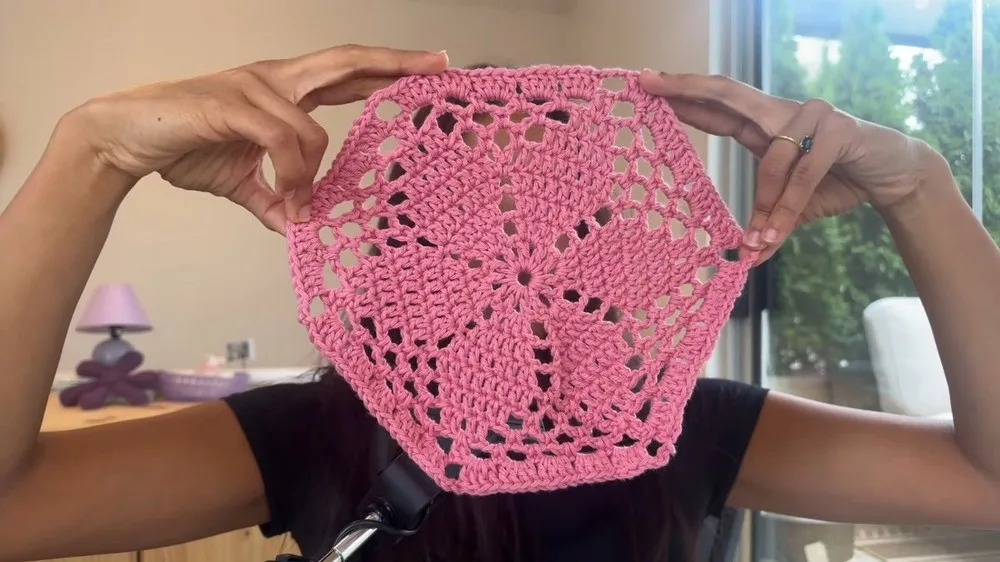
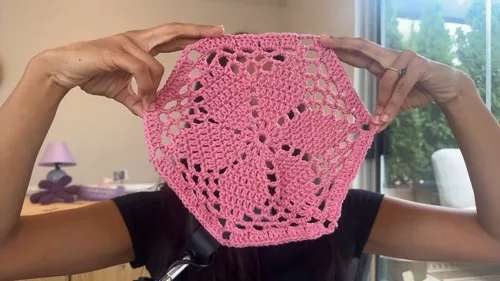
A crochet flower hexagon motif pattern worked in cotton, built up round by round from a chain ring to a
- Level
- Intermediate
- Time
- 2-3 hours
- Hook
- 4 mm
- Yarn
- Light (DK/Sport)
Pattern highlights
- Chain a small ring and close it with a slip stitch to start the flower center.
- Work double crochets into the ring with chain-1 gaps between each one.
- Close the first round with a slip stitch into the top of the starting chain.
- Begin the second row by working extra double crochets into each chain space.
- Continue building outward round by round until the hexagon shape is complete.
- Fasten off once all nine rounds are worked and the outline is even.
About This Pattern
Every collector's box has a motif drawer, and this one belongs there. A flower hexagon is the kind of piece you make one of to test, then find yourself making a dozen more of. It sits between coaster and blanket square, small enough to finish in an evening, structured enough to teach you something about how rounds turn corners.
The technique here is classic ring-and-round construction: a chain-6 base, a first round of double crochets separated by chain spaces, then a second row that starts building volume into those gaps. Nothing exotic, just the reliable logic of working outward from a center until the shape declares itself. Nine rounds is enough to watch a circle decide to become a hexagon.
What comes off the hook is a single flat hexagon, flower-centered, ready to stand alone as a coaster or wait in a pile for its siblings. Made in cotton, it holds its shape well and blocks flat without much fuss. I like a motif that does one job cleanly, and this one does.
Worth knowing
There's a real satisfaction in watching a ring of double crochets resolve into six flat sides. The chain-1 spaces from round one do double duty, first as texture, then as anchor points once row two starts filling them in. Cotton yarn size 3 keeps every stitch defined, so the flower center reads clearly even before blocking. It's a small, contained project — one ring, one join, nine rounds — which makes it a good test piece for anyone unsure about motif construction. And because it's a hexagon rather than a square, it tessellates differently, which is reason enough to make more than one.
Common mistakes
- Losing count in round Count the double crochet and chain-1 pairs as you go rather than at the end. It's easier to catch a missed repeat mid-round than after closing it.
- Ring pulled too tight or too loose Snug the chain-6 ring just enough to close without puckering. A too-tight ring distorts the flower center.
- Skipping the joining slip stitch Always slip stitch into the third chain of the starting chain-4, not just any nearby stitch. This keeps the round properly closed.
- Working into the wrong chain space In row two, count over to the actual chain-1 space rather than the stitch beside it. Working into the stitch instead of the space skews the hexagon corners.
- Ignoring gauge with cotton yarn Cotton has little give, so a loose gauge shows more than it would in wool. Check your first round lies flat before continuing.
Intermediate
Progress Tracker
0 of 0 rounds
Tap a round to tick it off — your place is saved on this device.
The kit
- 4 mm crochet hook
- Cotton yarn size 3
Main Pattern
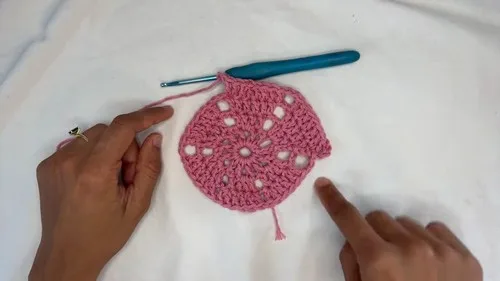
Round 1Start with a slip knot. Chain 6 to form the base ring. Join with a slip stitch into the first chain to close the ring.Chain 4 (counts as a double crochet and chain 1).Double crochet into the ring, then chain 1. Repeat from to a total of 11 times.Slip stitch into the 3rd chain of the initial chain-4 to close the row.
Round 2Chain 3 (counts as the first double crochet). Work 2 double crochets into the next chain space.Double crochet into the next double crochet.Chain 2.Row repeat begins: Double crochet into next double crochet, 2 double crochets into the next chain space, 1 double crochet on top of the next double crochet, chain 2. Repeat around.Finish with a slip stitch to the top of the initial chain-3.
Round 3Chain 3 and double crochet into the same place as the slip stitch. Double crochet into the next two stitches.Work 2 double crochets into the next stitch.Chain 2.Row repeat: 2 double crochets into the next double crochet, 1 double crochet into the next two stitches, 2 double crochets into the final double crochet, chain 2. Repeat around.Slip stitch into the top of the chain-3.
Round 4Chain 3, double crochet into the same place as the slip stitch. Double crochet into each of the next four stitches.Work 2 double crochets into the next stitch, then chain 2.Row repeat: 2 double crochets into the next stitch, 1 double crochet into each of the next 4 stitches, 2 double crochets into the final stitch, chain 2. Repeat around.Slip stitch to close.
Round 5Chain 3, double crochet into each of the next 7 stitches. Chain 3, single crochet into the next chain-2 space. Repeat for each side.Do 1 double crochet into each of the next 8 stitches to complete a side.Repeat this pattern all the way around.Finish with a slip stitch.
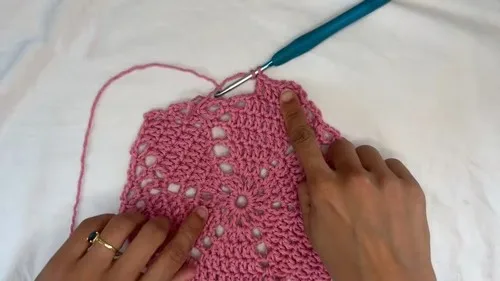
Round 6Slip stitch into the next stitch, then chain 3. Double crochet into the next 5 stitches.Chain 3, single crochet into the chain-3 space, repeated along the edge.Skip a stitch, then double crochet into each of the next 6 stitches.Repeat this sequence around.Close the row with a slip stitch.In Row 7 to Row 9: Follow a similar sequence of creating petals and chain spaces, gradually increasing the hexagon while maintaining the flower pattern at the center. Each row typically builds on the previous pattern—adding more double crochets in-between the chains and adjusting the petal shapes with strategic increases and chain spaces.
Round 9Slip stitch into the chain-3 space, then chain 3. Work 3 double crochets into the same space.Following the sequence to create the final hexagon shape, work a set of 4 double crochets into each chain-3 space around.Adjust with chain-3 spaces and skip stitches as needed to maintain the hexagon shape.Complete the motif by slip stitching into the top of the initial chain-3, then cut and secure your yarn.
From the collection
Finishing
- Weave in the starting and ending tails through the back of the stitches on the wrong side.
- Block the finished hexagon flat and let it dry to set the six-sided shape.
- Trim any remaining yarn ends close to the fabric once weaving is done.
Why it works
The chain-6 ring gives round one its 12 evenly spaced double crochets, which is the count that later divides cleanly into six hexagon corners.
The chain-1 spaces left between each double crochet in round one exist specifically so row two has somewhere to work its increases.
Closing each round with a slip stitch keeps the motif joined in continuous rounds rather than left as a spiral, which is what keeps the hexagon edges crisp.
What it becomes
- A single hexagon works well as a coaster paired with a plain mug and a wooden tray.
- Several joined hexagons make a lightweight table runner for a kitchen or reading nook.
- A larger cluster becomes a throw or blanket panel, especially alongside plain granny squares.
Original pattern: https://crocheteverything.com/crochet-motif-flower-hexagon-pattern/
FAQ
How many hexagons do I need for a blanket?
That depends entirely on your target size, since the pattern gives only the single-motif instructions. Make one, measure it, then calculate from there.
Why does my hexagon cup instead of lying flat?
Cupping usually means the increases in the later rounds are too tight or too loose relative to round one. Try blocking it first; if it still domes, check your tension is consistent across rounds.
Is this pattern good for a beginner?
It assumes comfort with chain, double crochet, and slip stitch joins. A confident beginner who has made a granny square before should manage it fine.