Free Pattern
Step-by-Step
Crochet
Home DecorTextured lace panel crochet table runner pattern
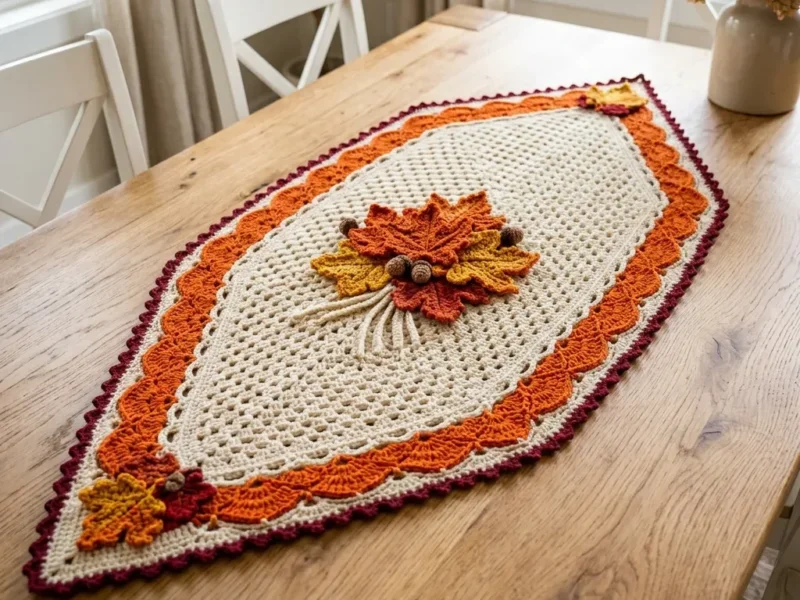
A rectangular crochet table runner with a lace shell panel and scalloped border.
- Level
- Intermediate
- Time
- 4-6 hours
- Hook
- 4.0 mm
- Yarn
- Worsted
Pattern highlights
- Chain a long foundation and build several rows of solid double crochet to start the textured panel.
- Work a row of single crochet separated by chain-2 spaces to set up the lace section.
- Fill those chain spaces with lace shells and single crochet to open up the center.
- Return to solid double crochet rows to close the lace panel back into dense fabric.
- Single crochet around the entire rectangle, tripling the stitch count at each corner so it lies flat.
- Add a second border round of shells worked into skipped stitches for a scalloped edge.
- Finish with a plain single crochet round, then join and weave in every yarn end.
About This Pattern
I keep a shelf of runners in my notebook, and this one earns its place. It sits between the plain textured strip and the full openwork showpiece. Most of my runners pick a side; this one asks for both, solid rows next to lace, without feeling indecisive.
The build leans on double crochet rows, a row of spaced single crochet and chain, then a row of lace shells dropped into those chain spaces. After that, a single-crochet border with a 5-dc shell in every third stitch frames the whole thing. Nothing exotic, just well-placed basics.
What comes off the hook is a long rectangle, dense enough to hold its shape on a table, open enough in the center to let light through. It is the kind of piece that looks more complicated than it is, which I appreciate in a centerpiece.
Finished size runs about 14 x 42 inches (36 x 107 cm), at a gauge of 18 double crochet stitches by 10 rows = 4 inches (10 cm). Always check gauge before beginning the full runner, since small differences in tension can significantly change the final width and length of a long rectangular project. This pattern uses US crochet terms and suits confident beginners through intermediate crocheters.
Worth knowing
The satisfaction here is in the middle rows, where a plain fabric suddenly opens into chain-2 spaces and then closes back up with lace shells. Working a lace shell, two double crochet, a chain, two more double crochet, into a space you made two rows earlier feels like checking your own work. The scalloped border adds a second payoff: five double crochet fanning out of a single stitch, with plain single crochet holding the rhythm between them. It is a short list of stitches, repeated with intention, and the contrast between dense rows and airy ones is what makes the finished rectangle worth setting a table around instead of folding into a drawer.
Common mistakes
- Skipping the gauge swatch Check gauge before starting, since a long rectangle magnifies small tension differences into real width and length changes.
- Uneven edges along rows Uneven edges usually happen when stitches are accidentally added or skipped at the beginning or end of rows. Count your stitches after every solid double crochet row to maintain the correct width.
- Loose lace sections If chain spaces appear too large, try a smaller hook size. If the fabric feels stiff, move up slightly in hook size while checking the finished measurements.
- Flat corners on the border Place three single crochet into each corner stitch on the first border round so the trim has room to turn.
- Messy color changes When changing colors, secure yarn tails as you work when possible. This reduces finishing time and keeps the back of the runner neat.

Intermediate
Progress Tracker
0 of 0 rounds
Tap a round to tick it off — your place is saved on this device.
The kit
Cream
- 300 yards (274 meters)
Rust orange
- 120 yards (110 meters)
Olive green
- 120 yards (110 meters)
Golden brown
- 110 yards (100 meters)
- 4.0 mm US G-6 crochet hook
- Yarn needle for weaving ends
- Scissors
- Blocking mat and pins
Main Pattern
Construction Notes: The runner is worked from one end to the other in rows. Turning chains count as the first stitch in double crochet rows. Slip stitches are used only for joining the border and do not count as stitches.
Starting Chain: With cream yarn, chain 65.
Row 1Dc in fourth ch from hook and in each ch across. Turn. (62 dc)
Row 2Ch 3, dc in each stitch across. Turn. (62 dc)
Row 3Ch 1, sc in first stitch, *ch 2, sk next 2 stitches, sc in next stitch; rep from * across. Turn. (21 sc and 20 ch-2 spaces)
Row 4Ch 3, 2 dc in first ch-2 space, *sc in next ch-2 space, lace shell in next ch-2 space; rep across, ending with 2 dc in last space. Turn.
Row 5Ch 3, dc across, working one dc into each stitch and chain space. Turn. (62 dc)Rows 6-18: Repeat Rows 3-5, ending after a Row 5 repeat.Color Change: Change colors every 3 completed repeat sections if desired. Suggested sequence: cream, rust, cream, olive, cream, golden brown.
Border Instructions
Do not fasten off after the final row.
Round 1Ch 1, work sc evenly around the entire rectangle. Place 3 sc in each corner stitch to help the corners turn smoothly. Join with sl st to first sc.
Round 2Ch 1, sc in next stitch, *skip 2 stitches, work 5 dc in next stitch, skip 2 stitches, sc in next stitch; repeat around. Join with sl st.
Round 3Ch 1, sc in each stitch around. Join and fasten off.Weave in all yarn ends securely.
Special Stitch
Lace Shell: In the indicated stitch or chain space, work (2 dc, ch 1, 2 dc). This creates an open decorative section.
Assembly
Step 1After completing the crochet table runner, gently wash it according to the yarn instructions and lay it flat to dry. Pin the edges into a rectangular shape while damp to improve the overall appearance.
Step 2Store the runner folded loosely in a dry place. Avoid hanging it for long periods because the weight of the yarn may stretch the fabric.
Finishing
- Weave in every yarn end left from color changes along the row edges before blocking.
- Wash the finished runner according to the yarn label, then lay it flat while damp.
- Pin the edges into a true rectangle while it dries so the scalloped border sits even.
Why it works
The lace row depends on the row before it: each ch-2 space from the spaced single crochet row becomes the home for a lace shell or a single crochet in the next row, so row order matters.
The body is worked flat in turned rows rather than in the round, which keeps the long rectangle from twisting and lets color changes happen cleanly at row ends.
The border is added after the rectangle is complete, working three single crochet into each corner stitch so the trim turns the corner without puckering or pulling tight.
What it becomes
- A centerpiece runner for a wooden dining table, paired with simple stoneware and a low candle.
- A dresser or console topper under a lamp, where the lace panel catches side light.
- A sideboard accent beneath a bowl of pumpkins or a stack of linens for seasonal display.
Original pattern: https://duniarecipe.com/8-crochet-table-runner-ideas-for-cozy-autumn-dining-decor-and-diy-inspiration/
FAQ
Can I change the yarn colors from the autumn palette?
Yes, the construction stays the same regardless of color. Swap in spring, winter, or farmhouse shades and the lace and shell structure will still read clearly.
Why does gauge matter so much for a runner?
A runner is long and narrow, so a small tension shift multiplies across every row. Checking gauge first keeps the finished length and width close to what you planned.
What does the lace shell actually look like in the fabric?
It is two double crochet, a chain, then two more double crochet, worked into one space. That chain at the center is what keeps the section open and airy.
Is the border worked separately from the main rectangle?
No, it is worked directly onto the completed rectangle in rounds. The first round sets up stitch placement with corner increases, and the shell round builds the scalloped look on top of it.