Free Pattern
Step-by-Step
Crochet
Home DecorCrochet snowflake coaster pattern for winter tables
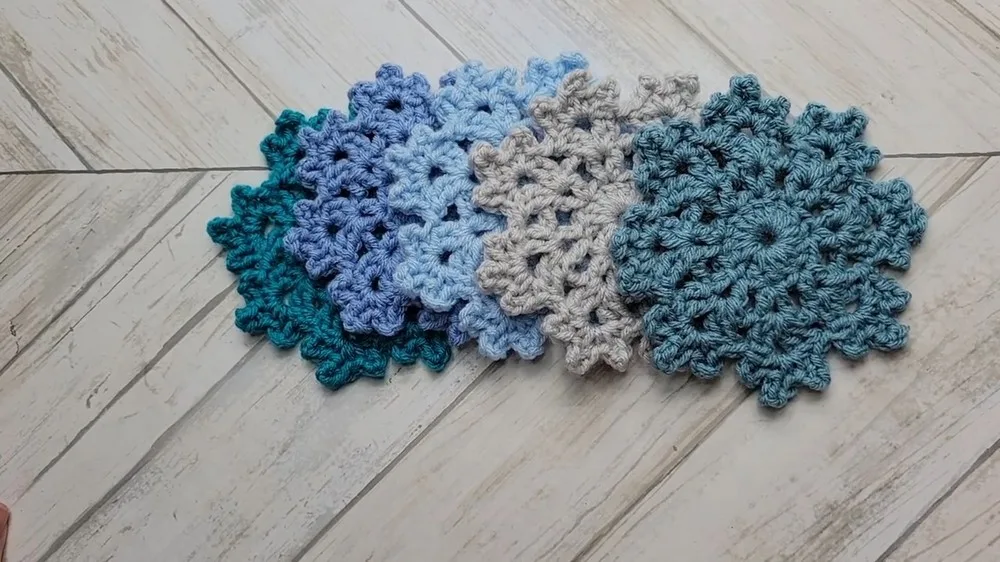
A round crochet snowflake coaster worked in five rounds with dc clusters.
- Level
- Intermediate
- Time
- 4-6 hours
- Yarn
- Worsted
Pattern highlights
- Start with a small chain loop and work the first round of dc stitches directly into it.
- Build round two by alternating sc and dc with chain-2 gaps to start shaping the points.
- Continue through the remaining rounds, repeating the chain-and-dc pattern to widen the snowflake.
- Close each round with a slip stitch into the top of the first dc before moving on.
- Tuck in the ends with a yarn needle once the last round is complete.
- Weave in any loose ends so the back lies flat against a tabletop.
About This Pattern
I keep a drawer of coasters I never set a mug on, just to study the shapes. This snowflake belongs there. It is small, round, built from a handful of rounds, and it earns its spot through the way the dc clusters fan out from the center. Coasters are where I test a stitch pattern before trusting it with something bigger.
The technique here is simple but has a trick to it: an alternate dc method worked into a chain loop, then chain-2 spaces that open up as the rounds build out. Each round adds its own rhythm of dc, chain, skip. It is the kind of repeat that becomes automatic by round three, which is exactly when the piece starts looking like a snowflake instead of a circle.
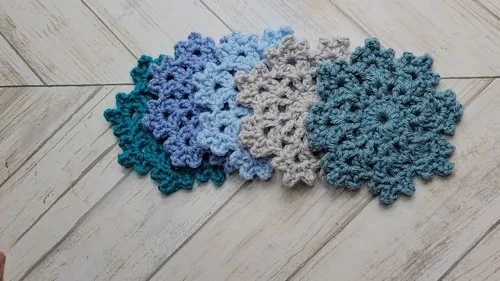
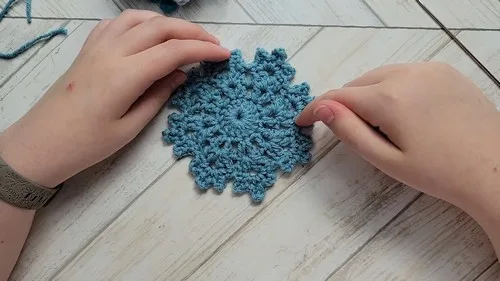
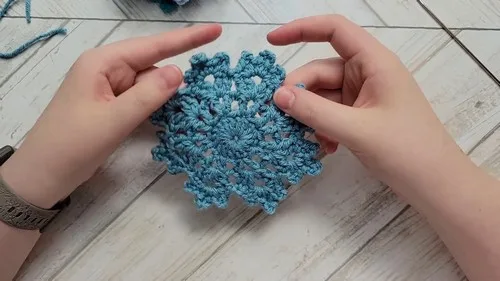
What comes off the hook is flat, symmetrical, and sized for a cup. It is worked in a single piece with no seaming, just ends to tuck in. I like that it finishes fast and sits ready to use the same evening, no blocking board required unless the yarn insists on curling at the edges.
Worth knowing
There is something satisfying about watching a loose little loop of five chains turn into a full snowflake just by repeating a chain-2, skip, dc sequence around and around. I like that the alternate dc method gets used twice here, once at the center and again in round two, so I get to practice the same small trick in two different contexts. The chain-2 spaces are what give the piece its points, and they appear almost by accident once the round count climbs. It is a project I can finish in one sitting, and it uses so little yarn that I never feel precious about trying a new colorway. Five rounds, one coaster, no regrets.
Common mistakes
- Losing track of the starting loop Mark the first stitch of round 1 with a scrap of yarn so the final slip stitch lands in the right place.
- Skipping the wrong stitch Count stitches before each skip in the chain-2 sequence rather than guessing by eye.
- Uneven chain-2 spaces Pull each chain to the same length as the last so the points end up symmetrical.
- Tight center loop Keep the first chain-5 loop loose enough that the round 1 dc stitches aren't fighting for room.
- Forgetting the alternate dc method Reread the alternate method note before each round that calls for it so the stitch count comes out right.
Intermediate
Progress Tracker
0 of 0 rounds
Tap a round to tick it off — your place is saved on this device.
The kit
- Size 4 acrylic yarn (I use I love this yarn from Hobby Lobby, but you can use any size 4 yarn)
- Crochet hook size 4
- Scissors
- Sewing needle
Main Pattern
Round 1ch 5, sl st in the first ch to form a loop Alternate method for dc: sc in the loop, sc in the same loop ch 1, dc in the same loop (you should now have 2 dc in the loop) ch 2, skip the next stitch, dc in the following stitch ch 1, dc in the same stitch Repeat the last 2 steps 13 more times (you should now have a total of 16 dc) sl st in the top of the first dc
Round 2ch 1, sc in the same stitch sc in the next stitch Alternate method for dc: ch 3, skip the next stitch, dc in the following stitch ch 1, dc in the same stitch Repeat the last 2 steps 7 more times (you should now have a total of 8 dc) sl st in the top of the first dc
Round 3ch 1, sc in the same stitch sc in the next stitch ch 3, skip the next stitch, dc in the following stitch ch 1, dc in the same stitch ch 2, skip the next stitch, dc in the following stitch ch 1, dc in the same stitch Repeat the last 4 steps 3 more times (you should now have a total of 4 dc) sl st in the top of the first dc
Round 4ch 1, sc in the same stitch sc in the next stitch ch 3, skip the next stitch, dc in the following stitch ch 1, dc in the same stitch ch 2, skip the next stitch, dc in the following stitch ch 1, dc in the same stitch Repeat the last 4 steps once more (you should now have a total of 2 dc) sl st in the top of the first dc
Round 5ch 1, sc in the same stitch sc in the next stitch ch 3, skip the next stitch, dc in the following stitch ch 1, dc in the same stitch ch 2, skip the next stitch, dc in the following stitch ch 1, dc in the same stitch Repeat the last 4 steps once more (you should now have a total of 2 dc) sl st in the top of the first dc ch 1, fasten off, leaving a short tail
Assembly
Step 1Tuck in the ends using a yarn needle.
Step 2Weave in any loose ends.
From the collection
Finishing
- Tuck in the tail at the center loop first, since it is the hardest spot to reach later.
- Weave in the working end along the back of the last round using a sewing needle.
- Press the coaster flat under a book overnight if the edges want to cup.
Why it works
Round 1 works entirely into the starting chain loop, which is why the center stays dense and tight.
The chain-2 spaces introduced in round 2 are what force the piece to widen into points rather than staying a flat disc.
Each round closes with a slip stitch into the top of the first dc, which keeps the spiral from drifting off-round.
What it becomes
- Set under a mug on a side table, paired with a wool throw for a cozy reading corner.
- Give as a small set of four alongside a mismatched mug for a housewarming gift.
- Layer a few in different colorways on a windowsill as a quick seasonal display piece.
Original pattern: https://crocheteverything.com/crochet-coaster-snowflake-tutorial-perfect-for-winter/
FAQ
How much yarn does one coaster use?
It is a small piece worked over five rounds, so it only takes a short length of yarn. I usually have enough left on a partial skein to make several in different colors.
Why does round 2 use an alternate dc method?
The alternate method is just another way to work the dc stitches into the same spot without losing the chain-2 spacing. It keeps the stitch count accurate once the piece starts widening.
Does this coaster need blocking?
Not strictly, but pressing it flat under a book overnight helps if the edges curl. Acrylic yarn tends to hold its shape once it has dried flat.