Free Pattern
Step-by-Step
Crochet
Baby & KidsLavender fields crochet baby dress: floral heirloom pattern
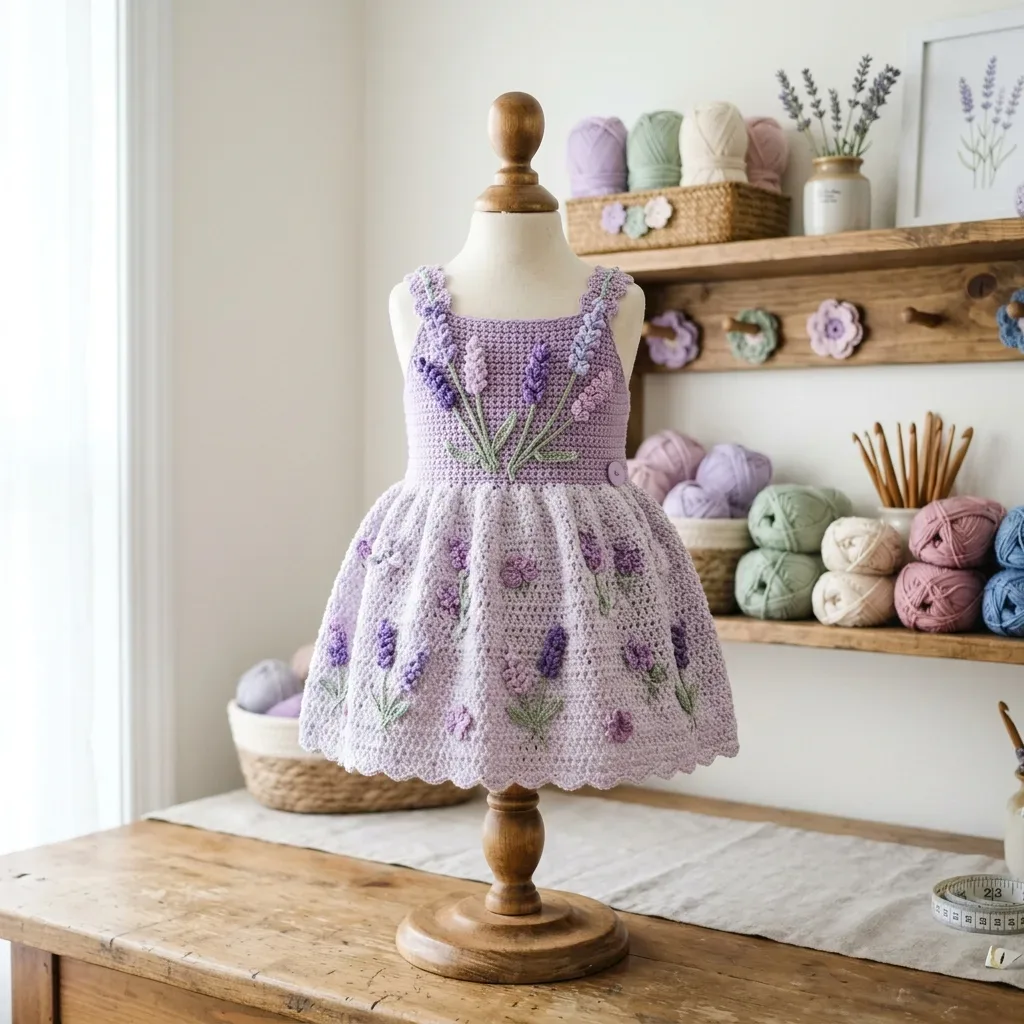
Crochet a lavender fields baby dress with a lacy skirt, button-back bodice, and floral appliques. A sweet heirloom-style pattern for special occasions.
Level IntermediateTime 6-9 HoursHook 3.5 mmYarn DK
Pattern highlights
- Chain and work the bodice front flat in single crochet rows to form the base rectangle before shaping begins.
- Split the top rows into a left strap, a center chest panel, and a right strap, working each section separately.
- Chain and work the bodice back in two separate panels, each finishing in its own narrow shoulder strap.
- Fasten off each strap and panel piece as you finish it, weaving in ends before moving to the next section.
- Whipstitch the finished bodice front to the bodice back along both side seams to form the fitted top.
- Wet block the entire dress flat, pinning it into shape before adding any further embellishment.
- Embroider the lavender spike clusters and sprigs onto the bodice front, then attach the buttons to complete the closure.
About This Pattern
This lavender fields baby dress pairs a fitted, button-back bodice with a lacy skirt and a scattering of dimensional lavender sprigs across the chest panel. It's the kind of piece that turns a simple baby garment into a keepsake — worked in soft DK weight yarn with a gentle color palette of pale lavender, deep purple, and sage green. If you love florals and fine detail work but still want a project that finishes in a reasonable amount of time, this dress hits that sweet spot perfectly.
You'll work the bodice front and back flat in single crochet, shaping individual shoulder straps by working across only portions of your stitches, then join everything with a whipstitch seam before working the skirt in the round with a scalloped lace edge. The lavender motifs are added afterward as surface embroidery and applied spike clusters, so the construction itself stays approachable. Expect an intermediate-level project — comfortable if you've made a garment or two before, with clear stitch counts guiding every row.
The finished dress has that heirloom quality — a snug, tailored bodice that buttons at the back, flowing into a soft, lacy skirt that moves beautifully on a little one. It photographs gorgeously for milestone moments and makes an exceptional handmade baby gift, whether for a shower, a christening, or simply because someone you love is expecting. The lavender detailing gives it a botanical, garden-party feel that feels far more special than store-bought.
Variations
The lavender palette is gorgeous, but this dress is incredibly easy to reimagine in other color stories. Try a sage-and-cream combo for a woodland christening look, or swap in soft pink with a deeper rose for a classic girly version — just keep the same three-color contrast ratio (a generous main color, a supporting pale shade, and two smaller accent amounts) so the floral motifs still pop. A butter-yellow main with white and sage accents would give you a cheerful daisy-field feel instead of lavender. For sizing, this pattern is written for one baby size, but confident crocheters can adjust the foundation chain length and row count proportionally for a newborn or a older toddler size — just remember to swatch first, since changing stitch count will shift your gauge math for the strap splits. If you want a quicker version, skip the applied spike clusters and stick to simple embroidered French knots or lazy-daisy stitches for the lavender sprigs; it's a lovely simplified alternative for a first-time garment maker. Yarn-wise, any DK weight acrylic or superwash wool works beautifully here, and acrylic is a smart pick for baby items since it's machine washable and holds its shape well after blocking. If you prefer a more rustic, textured look, a lightly heathered lavender yarn adds gorgeous depth to the bodice without any extra effort. You could also add a matching headband using the same scallop edging stitch from the skirt, or work a few extra spike clusters onto a plain onesie for a coordinating sibling set. Buttons are another easy customization — swap the pearl buttons for tiny wooden or enamel flower-shaped ones to echo the lavender theme even further.
Common mistakes
- Losing track of which stitches belong to which strap when splitting the bodice front at Row 7.
- Place a stitch marker at the edges of the chest panel before you start dividing, so you always know exactly where the left strap, chest panel, and right strap begin and end.
- Counting the turning chain as a stitch, which throws off your stitch count on every subsequent row.
- Remember turning chains never count as stitches in this pattern — always work your first single crochet directly into the first actual stitch, not into the chain.
- Skipping the gauge swatch and ending up with a bodice that doesn't match the intended fit.
- Work the recommended 5 in / 13 cm swatch in both the bodice single crochet and the skirt lace pattern before casting on, adjusting hook size if needed.
- Adding the lavender spike clusters and embroidery before blocking the dress.
- Wait until the entire dress is assembled and wet blocked before attaching any appliques — blocking first keeps your surface embroidery flat and evenly tensioned.
- Joining the front and back at the sides before checking that both bodice pieces are the same length.
- Lay the finished bodice front and back flat side by side and confirm row counts and measurements match before whipstitching the side seams.
Intermediate
Progress Tracker
0 of 0 rounds
Tap a round to tick it off — your place is saved on this device.
Materials
- MC (main lavender): approximately 250 yards / 229 m
- CC1 (pale lavender or soft white): approximately 180 yards / 165 m
- CC2 (deep purple): approximately 40 yards / 37 m
- CC3 (sage green): approximately 25 yards / 23 m
- Paintbox Yarns Simply DK (100% acrylic, 276 yards / 252 m per 100 g skein) offers machine washability and excellent stitch definition for showing the lace pattern clearly.
- Lion Brand Pound of Love (100% acrylic, 1020 yards / 932 m per 16 oz skein) is extremely soft against baby skin and provides ample yardage if you purchase coordinating colors.
- Cascade Yarns 220 Superwash (100% superwash wool, 220 yards / 200 m per 100 g skein) produces the most heirloom appearance with superior stitch definition and beautiful drape after blocking.
- Avoid highly textured, fuzzy, or bouclé yarns as the lace pattern and applique details will be obscured. Always verify your yarn is machine washable for a baby garment.
- US size E-4 / 3.5 mm for bodice and appliques
- US size F-5 / 3.75 mm for skirt lace section (the larger hook creates appropriate drape)
- Yarn needle for finishing
- 3 small buttons, approximately 0.5 in / 12 mm diameter, in lavender or pearl
- Stitch markers, at least 6
- Rust-proof pins for blocking
- Scissors
Bodice Front
The top 10 stitches on each edge form the shoulder straps; the center 28 stitches form the chest panel. Beginning on Row 7, work only the left strap first.
For the Right Strap: with RS facing, skip the center 28 sts of Row 6 and join MC in the 39th stitch.
After Row 22 on the left strap, it measures approximately 2.5 in / 6.4 cm from Row 7; fasten off MC and set aside.
After Row 22 on the right strap, do not fasten off; set aside.
After Row 36, do not fasten off; secure the working loop on a stitch marker.
Checkpoint: the bodice front should measure approximately 6 in / 15 cm tall and 9 in / 23 cm wide.
Foundation: With MC and smaller hook, chain 49.
- Round 1(RS): Sc in second ch from hook and in each ch across. Ch 1, turn. (48 sc)
- Round 2(WS): Sc in each st across. Ch 1, turn. (48 sc)
- Round 3(RS): Sc in each st across. Ch 1, turn. (48 sc)
- Round 4through 6: Repeat Row 2. (48 sc at end of each row)
- Round 7(RS) [Left Strap]: Sc in first 10 sts. Ch 1, turn. Leave remaining 38 sts unworked. (10 sc)
- Round 8through 22 [Left Strap]: Sc in each st across. Ch 1, turn. (10 sc per row)(10)
- Round 7(RS) [Right Strap]: Sc in this st and in each of the last 10 sts. Ch 1, turn. (10 sc)
- Round 8through 22 [Right Strap]: Sc in each st across. Ch 1, turn. (10 sc per row)Joining Row (Row 23, RS): With RS facing and working yarn still attached to right strap, sc across the 10 sts of the right strap, ch 28 (these chains bridge the neckline gap), then sc across the 10 sts of the left strap. Ch 1, turn. (48 sts: 10 sc + 28 ch + 10 sc)(10)
- Round 24(WS): Sc in each of the 10 right strap sts, sc in each of the 28 chain sts, sc in each of the 10 left strap sts. Ch 1, turn. (48 sc)
- Round 25through 36: Sc in each st across. Ch 1, turn. (48 sc per row)(48)
Bodice Back
The back is worked similarly to the front but split at center back for the button closure.
Fasten off MC after the Left Back Strap and set aside.
The Right Back Strap begins at Row 7, but the source text is truncated before the instructions could be completed.
Foundation [Left Back Panel]: With MC and smaller hook, chain 25.
- Round 1(RS) [Left Back Panel]: Sc in second ch from hook and in each ch across. Ch 1, turn. (24 sc)
- Round 2through 6 [Left Back Panel]: Sc in each st across. Ch 1, turn. (24 sc per row)(24)
- Round 7(RS) [Left Back Strap]: Sc in first 10 sts. Ch 1, turn. (10 sc)
- Round 8through 22 [Left Back Strap]: Sc in each st across. Ch 1, turn. (10 sc per row)Foundation [Right Back Panel]: With MC and smaller hook, chain 25.(10)
- Round 1(RS) [Right Back Panel]: Sc in second ch from hook and in each ch across. Ch 1, turn. (24 sc)
- Round 2through 6 [Right Back Panel]: Sc in each st across. Ch 1, turn. (24 sc per row)(24)
Assembly
- Step 1Join the bodice front and back at the sides with a whipstitch seam.
- Step 2Work the skirt in the round from the joined waist edge.
- Step 3The lavender motif on the bodice front is worked as surface embroidery and applied spike clusters after the bodice is complete; do not incorporate it during construction.
- Step 4Block the finished dress before attaching appliques; wet blocking is strongly recommended.
Important notes
Always count your stitches at the end of every row and round — the parenthetical counts are there to catch mistakes early, especially during the strap-splitting rows.
Use stitch markers generously, particularly at the start of each skirt round and at the boundaries between the chest panel and each shoulder strap on the bodice front.
Work a swatch in both the bodice single crochet and the skirt's lace pattern before beginning, since the two sections use different hook sizes and stitch structures.
Fasten off and weave in ends securely after each strap and panel section rather than carrying yarn across, since the bodice pieces are worked with distinct start and stop points.
Save the lavender spike clusters and surface embroidery for last — they're applied after the entire dress is constructed and blocked, not built into the rows as you go.
Use rust-proof pins and wet block the finished dress before attaching any buttons or appliques, which keeps both the fabric and your embroidery threads lying flat and even.
Turning chains do not count as stitches throughout the bodice; begin every row with ch 1, turn, then work your first sc into the first stitch.
Always count your stitches at the end of each row and round; place a stitch marker at the beginning of each round in the skirt.
All stitch counts appear in parentheses at the end of each row or round.
Work a 5 in / 13 cm swatch in each stitch pattern before beginning.
Scallop Edging Stitch: slip stitch into first stitch to anchor; ch 3; work 2 dc into same stitch as slip stitch; skip 2 stitches; slip stitch into next stitch; repeat across the edge (each scallop uses 3 stitches, so stitch count must be divisible by 3 for even scallops).
Lavender Spike Cluster (lv-sp): join CC2 to the working stitch; ch 1; (yo, insert hook into same stitch, pull up loop, yo, pull through 2 loops) worked 3 times total in the same stitch (3 half-closed dc on hook, 4 loops total); yo and pull through all 4 loops to close the bobble; ch 1 to lock. Work clusters in groups of 5 to 7 to form each lavender stem.
Shell Stitch: work 5 dc into a single stitch or chain space as directed; all shell stitches in the skirt use 5 dc unless otherwise noted.
Small Flower Applique: with CC2, make a magic ring; ch 3, work 1 dc into the ring, ch 3, sl st into ring (first petal complete); repeat 4 more times for a total of 5 petals; pull ring closed and fasten off, leaving a 6 in / 15 cm tail for sewing; with CC3, embroider a small French knot at the center.
The source text is truncated mid-instruction at 'Right Back Strap: Row 7'; skirt, applique, and remaining assembly instructions beyond this point were not available in the provided source text.
FAQ
What yarn weight and hook sizes does this dress use?
The dress is worked in DK weight (CYCA 3) yarn using two hook sizes — a US E-4 / 3.5 mm hook for the bodice and appliques, and a slightly larger US F-5 / 3.75 mm hook for the lacy skirt section.
How is the button closure on the back constructed?
The bodice back is split into a left and right back panel worked separately, each forming its own shoulder strap; buttons and closures are added along the center back opening once both sides are complete.
When do I add the lavender floral details?
The lavender motifs are added last, as surface embroidery and applied spike clusters worked directly onto the finished, blocked bodice front — they are not built in during the main construction.
Can I substitute a different fiber for the yarn colors listed?
Yes — any DK weight acrylic or superwash wool works well for this pattern, though acrylic is especially practical for baby garments since it's machine washable and holds blocking well.
Why does the pattern use two different hook sizes?
The smaller hook keeps the bodice and applique stitches firm and structured for a fitted look, while the larger hook opens up the skirt's lace pattern for extra drape and movement.