Free Pattern
Step-by-Step
Crochet
Baby & KidsA mint daisy baby dress worked top-down in crochet
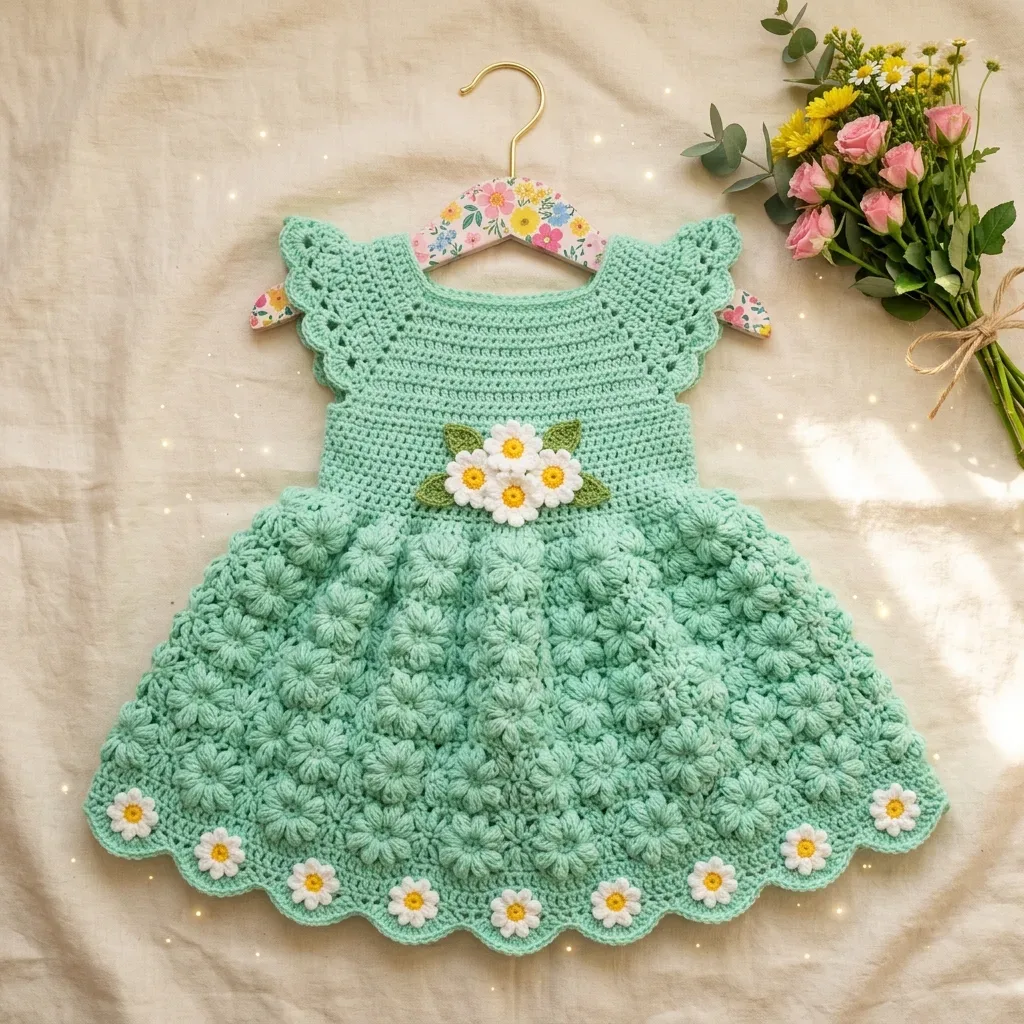
A mint green raglan baby dress with daisy appliques, worked top-down in joined rounds.
- Level
- Intermediate
- Time
- 4-6 hours
- Hook
- 4.0 mm
- Yarn
- Worsted
Pattern highlights
- Start the neckband worked flat in rows so the back opening forms naturally at the two short ends.
- Join the rows into a ring and place four stitch markers at the raglan division points.
- Work the raglan increase rounds, adding stitches at each marked point until the yoke is deep enough.
- Set the sleeve stitches aside on hold and continue the body from the underarm in joined rounds.
- Work the skirt in bubble stitch, alternating rounds as the pattern calls for.
- Make the daisy and leaf appliques separately in Color C, B, and D, then set them aside.
- Block the finished dress first, then sew on the daisies, leaves, and back buttons.
About This Pattern
This one lands in the baby-garment drawer of my notebook, next to other top-down raglans. I keep a running list of patterns that solve the back-opening problem cleanly, and this yoke does it without a seam. A dress with a built-in buttonhole gap is worth filing away for reference alone.
The interest here is in the raglan increase round and the bubble stitch skirt that follows it. Four marker points carry two increases each, which is a tidy way to shape a yoke without math on the fly. The daisy and leaf appliques are small separate makes, worked flat and sewn on after.
What comes off the hook is a mint green dress with a fitted yoke, angel wing ruffle sleeves at the armholes, a textured bubble stitch skirt, and white daisies scattered with yellow centers and green leaves. The back closes with small buttons through a gap left in the neckband. It reads as a piece for a baby shower table or a well-dressed afternoon.
Worth knowing
I like a pattern that teaches its own shaping as it goes, and this one does. The raglan increase round gives four clean diagonal lines without any guessing, and working the neckband in rows before joining solves the back opening in a way that feels obvious only after you have seen it. The daisies are their own small satisfaction: a magic ring center, eight chained petals, done in one sitting. The leaf applique tapers to a real point using three stitches worked into the last chain. None of it is hard. All of it rewards paying attention to where the markers go.
Common mistakes
- Twisting the neckband ring Check the row is flat before joining with a slip stitch, since a twist here is hard to undo later.
- Losing the raglan marker positions Place all four markers before the increase round starts, not partway through, so each raglan line stays straight.
- Uneven daisy petals Anchor each petal chain into a different stitch of the center ring, working around in order rather than skipping.
- Leaf applique losing its point Work the three single crochets into the last chain exactly as written; that step is what makes the tip.
- Attaching appliques before blocking Block the dress first, as the assembly notes specify, so placement sits correctly on the finished shape.
Intermediate
Progress Tracker
0 of 0 rounds
Tap a round to tick it off — your place is saved on this device.
The kit
Yarn
- Worsted weight yarn (Category 4), approximately 350 to 400 yards (320 to 366 m) in Mint Green (Color A)
- Small amount of White (Color B), approximately 30 yards (27 m) for daisy petals
- Small amount of Yellow (Color C), approximately 10 yards (9 m) for daisy centers
- Small amount of Green (Color D), approximately 15 yards (14 m) for leaves
Hooks
- US Size G-6 (4.0 mm) for yoke and skirt
- US Size E-4 (3.5 mm) for daisy appliques and leaves (optional, for tighter appliques)
Notions
- Stitch markers (at least 4)
- Yarn needle for weaving in ends
- 2 to 3 small buttons or snaps, approximately 0.5 inches (12 mm) diameter, for back closure
- Scissors
- Pins for blocking and applique placement
Yoke
Row 1(RS): With Color A and G-6 hook, ch 50. Sc in 2nd ch from hook and in each ch across. Turn. (49 sc)
Row 2(WS): Ch 1, sc in each st across. Turn. (49 sc)
Row 3(RS): Ch 1, sc in each st across. Do not turn. (49 sc)
At the end of Row 3, the two short ends of the neckband will form the back opening. Join with sl st to the first st of Row 3 to form a ring, being careful not to twist.
Place stitch markers at the following positions to denote raglan dividers: Marker 1 at stitch 7 (right back/right sleeve join); Marker 2 at stitch 20 (right sleeve/right front join); Marker 3 at stitch 30 (left front/left sleeve join); Marker 4 at stitch 43 (left sleeve/left back join).
Each raglan round increases 8 stitches total (2 increases at each of the 4 marked raglan points).
Raglan Increase Round (RIR): Sc in each st to 1 st before marker, inc in next st, sm, inc in marked st, sc in each st to 1 st before next marker, inc, sm, inc, continue in this manner at all 4 markers, sc to end of round, join with sl st. (total +8 sts per round)
Round 4RIR Work Raglan Increase Round. (57 sc)
Round 5Sc in each st around, join. (57 sc)
Round 6RIR Work Raglan Increase Round. (65 sc)
Round 7Sc in each st around, join. (65 sc)
Round 8RIR Work Raglan Increase Round. (73 sc)
Round 9Sc in each st around, join. (73 sc)
Round 10RIR Work Raglan Increase Round. (81 sc)
Round 11Sc in each st around, join. (81 sc)
Round 12RIR Work Raglan Increase Round. (89 sc)
Round 13Sc in each st around, join. (89 sc)
CHECKPOINT: After completing the yoke, the piece should measure approximately 3.75 to 4 inches from the neckline to the underarm, and approximately 18 inches around when the back opening is closed.
Daisy Flower Applique
Round 1With Color C, make a magic ring; work 8 sc into the magic ring; pull ring closed. (8 sc)
Round 2Join Color B; ch 8, sl st back into the base of that chain (this forms one petal); repeat seven more times, working each petal base into a different sc of the center ring. (8 petals total)(8)
Round 3Join with sl st to first sc. Fasten off, leaving a 12 inch tail for sewing.
Leaf Applique
Round 1With Color D, ch 8; sc in 2nd ch from hook, hdc in next ch, dc in next 2 ch, hdc in next ch, sc in next ch, 3 sc in last ch (tip of leaf); working back along the opposite side of the foundation chain: sc in next ch, hdc in next ch, dc in next 2 ch, hdc in next ch, sc in last ch.
Round 2Join with sl st to first sc. Fasten off, leaving a 10 inch tail for sewing.
Assembly
Step 1Flatten the daisy flower so the petals radiate evenly. Use the tail to sew to garment.
Step 2Block the finished dress before attaching appliques for the most accurate placement.
Finishing
- Weave in ends from the yoke, skirt, and each applique piece separately before assembly.
- Block the finished dress first, since the notes flag this as the step for accurate applique placement.
- Sew the daisies flat with petals radiating evenly, attach the leaves, then sew on the back buttons or snaps.
Why it works
The first three rows are worked flat rather than joined, which is what leaves the back opening for the buttons.
Each raglan round adds stitches at exactly four marked points, so the increases always fall at the same four seams as the yoke grows.
The skirt starts from stitches held at the underarm rather than from the main yoke round, separating body shaping from sleeve shaping.
What it becomes
- A baby shower gift, paired with plain white booties so the daisies stay the focal point.
- A photo-session outfit, worn over a simple onesie for a clean, uncluttered look.
- A warm-weather everyday dress, paired with leggings or sandals once the weather turns mild.
Original pattern: https://crochr.com/mint-green-daisy-baby-dress-free-crochet-pattern/
FAQ
Do I need two hook sizes?
The G-6 hook handles the yoke and skirt, and the E-4 is listed as optional for tighter daisy and leaf appliques. You can use just the G-6 throughout if you prefer a looser applique texture.
How does the back closure actually work?
The first rows are worked flat instead of joined, which leaves a gap of about an inch at the two short ends. That gap becomes the opening for the buttons or snaps once the neckband is joined into a round.
How much yarn do I need for the appliques?
The pattern calls for small amounts: about 30 yards of white for petals, 10 yards of yellow for centers, and 15 yards of green for leaves. The mint main color needs roughly 350 to 400 yards.
When should I attach the daisies and leaves?
The assembly notes say to block the dress first, then attach appliques for the most accurate placement. Sew them on with the tails left from fastening off each piece.