Free Pattern
Step-by-Step
Crochet
Motifs & SquaresRose flower crochet square for home decor projects
A three-color rose square built in layered petal rounds, for blankets and shawls.
- Level
- Intermediate
- Time
- 4-6 hours
- Hook
- 3 mm
- Yarn
- Worsted
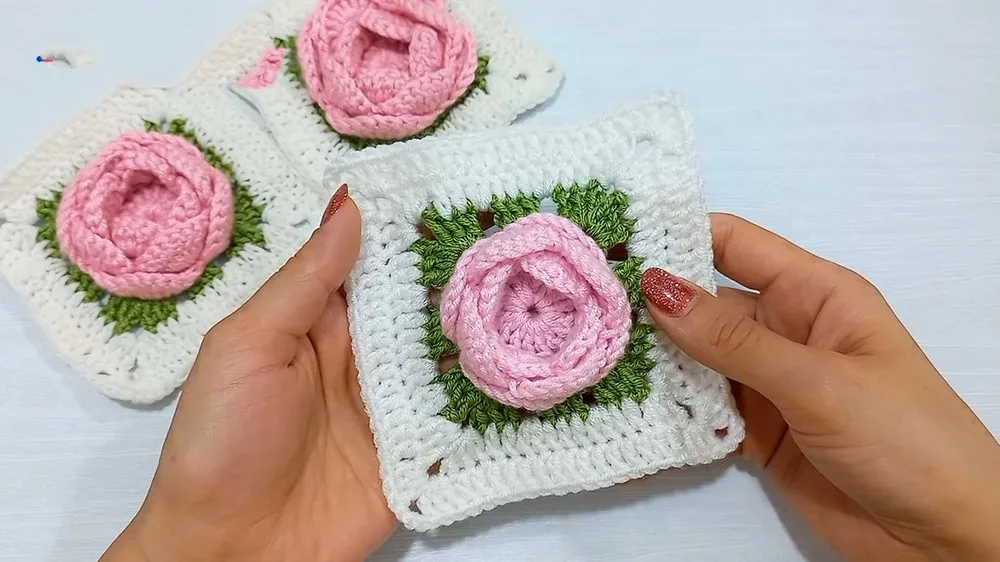
Pattern highlights
- Start with a ring of double crochets to form the flat base the whole flower will sit on.
- Work a round of single crochets and chain spaces to set up anchor points for the first petals.
- Fill those chain spaces with clusters of double crochets to form the first ring of petals.
- Work a round that reaches behind those petals, anchoring to stitches from two rounds below.
- Fill the new chain spaces with another, slightly larger ring of double crochet petals.
- Repeat the behind-the-work anchoring and petal-filling pattern to keep building layers.
- Once the rose is full, work a round of corner clusters and chain-2 spaces to turn the circle into a square.
About This Pattern
This one belongs in the drawer labeled 'motifs I keep coming back to.' Most squares in my collection settle for a flat center and a border. This one builds up instead of out, layer on layer, before it ever squares itself off. It's the kind of piece that makes me stop scrolling and start winding yarn.
The technique here is working behind the work. Each petal round is anchored to a single crochet from two rounds below, not the row directly under it. That's an unusual instruction to see written out plainly, and I like that it's not hidden behind vague language. The chain spaces widen each layer to make room for the next ring of petals to sit forward.
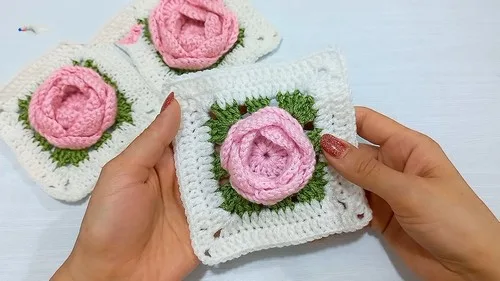
What comes out the other end is a rose sitting inside a square, in three colors, flat enough to join into a blanket or a shawl panel. It reads as floral without being fussy. I'd call it a square that earns its place on a project where every motif gets looked at twice.
Worth knowing
The satisfaction is in watching one shape become another. You start with sixteen double crochets in a ring, then coax eight petals out of chain-3 spaces, then go back and work behind those petals to start a second layer. That backward anchoring is the real trick of this square. It is not a stitch I use often, and doing it correctly feels like solving something small. Each round of petals sits slightly behind and larger than the last, so by the time the square shape appears, you have real dimension to show for it. For a motif square, that's rare. Most give you texture through popcorn stitches or clusters. This one gives you actual layered petals, and that's worth the extra round count.
Common mistakes
- Working into the wrong round Double check you're anchoring to the single crochet two rounds below, not the round directly beneath your hook. Count back before you insert.
- Losing track of chain-3 vs chain-4 spaces The spaces grow as layers stack, so glance at your previous round before starting a new one. A space that's the wrong size throws off the next petal count.
- Petals pulling flat instead of standing forward Make sure the anchoring single crochets sit behind the previous petals, not through them. This is what gives the rose its layered look.
- Uneven petal clusters Keep your double crochet count consistent within each chain space before moving to the next. A short petal next to a full one is easy to spot later.
Intermediate
Progress Tracker
0 of 0 rounds
Tap a round to tick it off — your place is saved on this device.
The kit
Yarn
- Alize Baby Best (Category 3 yarn)
- Crochet Hook: 3 mm
Starting Ring
Round 1Create a slip knot with your first yarn color. Chain 5, join with a slip stitch to the first chain to form a ring. Inside the ring, chain 3 (counts as the first double crochet), then make 15 more double crochets into the ring (16 double crochets total). Join with a slip stitch to the third chain of the beginning chains.
Petal Base
Round 2Chain 1, make a single crochet in the same chain on top of the first double crochet of the previous round. Chain 3, skip the next double crochet, single crochet in the next stitch. Repeat from to around. You should have eight single crochets and eight chain-3 spaces.
Round 3In the first chain-3 space, make a slip stitch and then start the round with 1 chain and a single crochet in the same space. In the next chain-3 space, make 7 double crochets. Then, single crochet in the next chain-3 space, 7 double crochets in the following chain-3 space. Repeat from to to create petals.
Adding Layers
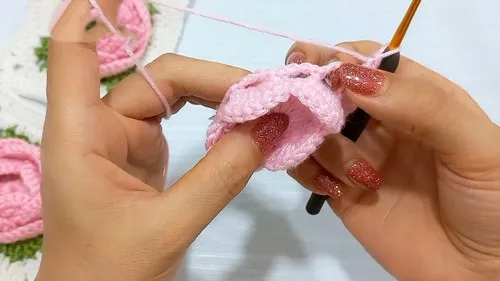
Round 4This begins the process of creating layers behind the first set of petals. Work a slip stitch around the single crochet from two rounds below. Chain 1 and make a single crochet around the same stitch. Then, chain 4, single crochet around the next single crochet from two rounds below. Repeat around, creating eight chain-4 spaces.
Round 5In a chain-4 space, slip stitch, and then chain 1 to start the round. Make a single crochet in the same space, then in the next chain space, work 9 double crochets to form the next layer of petals. Continue this pattern around.
Building the Square
Next Rounds: Continue creating layers of petals as established, increasing the chain spaces as needed for each layer to sit nicely behind the previous one.
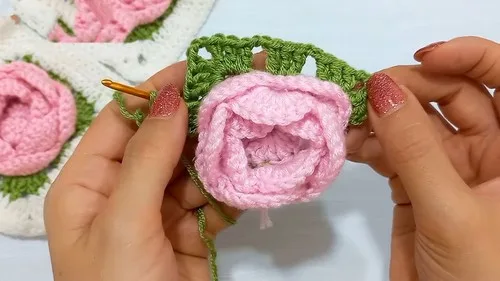
Square BorderWhen you've reached the desired amount of petal layers, start converting the round petal layers into a square. In a space, make 3 double crochets, 3 chains, and 3 more double crochets to form a corner. Chain 2, 3 double crochets in the next space, chain 2. Repeat around and join with a slip stitch to the beginning of the round.
Finishing Touches
BorderWith the third color, start in any corner. Make 3 chains (counts as a double crochet), 2 double crochets in the same space, skip a stitch, make a double crochet in each of the next two stitches, 2 double crochets in the chain-2 space. Repeat this pattern on each side and corner. Join with a slip stitch and finish off.
From the collection
Finishing
- Weave in the yarn ends from each color change close to the back of the rose, where the layers hide them.
- Steam or wet-block the finished square gently so the petal layers lie flat without flattening their dimension.
- If joining into a blanket or shawl, whipstitch or single crochet the squares together along the border rounds.
Why it works
The starting ring has no increases of its own; all sixteen double crochets sit in the same foundation chain-5 ring.
Each petal layer is anchored not to the round just worked, but to the single crochet two rounds below it, which is what lets the petals stack forward in layers instead of flattening into one ring.
The chain spaces grow from chain-3 to chain-4 as the rounds progress, giving each new layer of petals slightly more room to sit behind the one in front of it.
The round-to-square transition happens through corner clusters: 3 double crochets, a 3-chain corner, and 3 more double crochets, with chain-2 spaces and 3-double-crochet groups holding each straight side, before a final third-color round edges the whole square.
What it becomes
- A single square works well as a coaster-sized accent piece on a shelf or tray.
- Multiple squares joined together make a shawl panel with a floral, dimensional surface.
- Repeated across a larger piece, the squares build into a blanket with raised rose detail throughout.
FAQ
Why does the pattern say to work behind the single crochet two rounds below?
That's how each petal layer stacks forward instead of lying flat against the last one. It's an anchoring technique, not a typo, and it's the core trick of this square.
Do I need to use three different yarn colors?
The pattern is written for three colors to separate the rose layers from the square border visually. You could use fewer, but the layered look reads better with color changes marking each part.
Why does the base round use a ring of double crochets instead of single crochets?
The taller double crochet stitches give the starting ring enough height and spread to support sixteen stitches without buckling. That foundation is what the petal rounds build on.
What hook and yarn does this call for?
The pattern uses a category 3 yarn, specifically Alize Baby Best, with a 3 mm hook. That combination keeps the petal layers tight and well-defined rather than loose.
How does the round rose become a square?
Once the petal layers are done, one round converts the circle into a square by working corner clusters of 3 double crochets, a chain-3 corner, and 3 more double crochets, with chain-2 spaces holding 3-double-crochet groups along each side. A final round in the third color then edges that square.