Free Pattern
Step-by-Step
Crochet
AmigurumiSad hamster amigurumi crochet pattern with cinched face
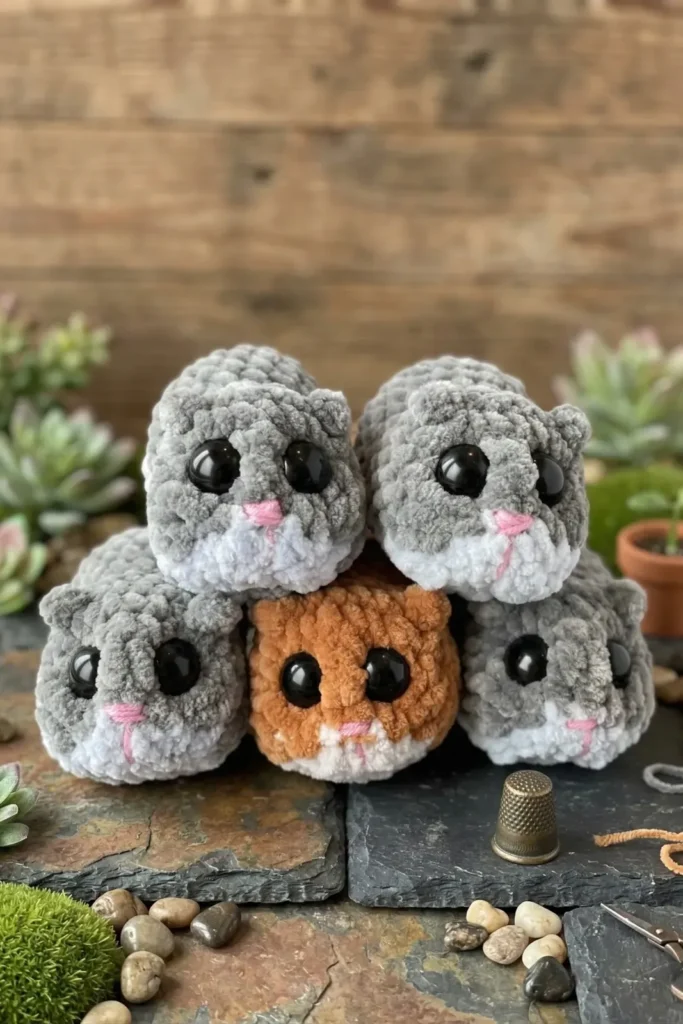
A small crocheted hamster with a cinched, pouty face using safety eyes.
- Level
- Intermediate
- Time
- 4-6 hours
- Hook
- 14 mm
- Yarn
- Worsted
Pattern highlights
- Start the head-and-body as one continuous piece worked in rounds from a small center.
- Increase steadily through the first few rounds, shifting between sc, hdc, and dc as the shape widens.
- Work the ears directly into the body rounds rather than crocheting them separately.
- Continue through the remaining rounds to build out the full body shape before stuffing.
- Insert the safety eyes at the point the pattern indicates, before the head closes up too far.
- Stuff the piece firmly, then use a tapestry needle to cinch the face in two passes for the sad expression.
- Weave in any loose ends and give the finished hamster a final shape check.
About This Pattern
Every collection needs one piece that isn't smiling. This hamster earns its spot on the shelf by looking mildly done with everything, which is rarer in amigurumi than you'd think. Most patterns chase cute and cheerful. This one chases mood, and that makes it worth the hook time.
The technique that carries the whole piece is face cinching — pulling yarn through the head with a tapestry needle to sink the safety eyes and set that pouty tilt. Two passes, not one. It's a small sculptural move layered onto an otherwise ordinary body-and-head build in two yarn colors.
What comes off the hook is a single stuffed head-and-body unit, worked in one continuous piece across fourteen rounds. No separate limbs to attach here — the shaping does the work. The finished hamster sits low and round, with an expression you set yourself at the cinching stage.
Worth knowing
The satisfaction here isn't in the stitch count — it's in the cinching. You crochet a fairly plain rounded body, then reach for the tapestry needle and physically sculpt the sadness into it. Two passes, and the safety eyes sink just enough to change the whole read of the face. It's the closest amigurumi gets to sculpting with thread. The early rounds mix hdc, dc, and sc increases in quick succession, so you're paying attention from round one, not coasting. And because the ears show up worked into round five rather than added later, the shaping stays continuous. There's no separate seam to fuss over, no limb to set at the wrong angle. Just one piece, one expression, decided at the very end.
Common mistakes
- Placing the safety eyes too early Wait until the head rounds are close to the size stated before inserting them. Going in too soon makes it hard to judge spacing on the still-small head.
- Skipping the second cinching pass One pass rarely sinks the face enough for the sad look. Do both passes as instructed, checking the expression after each before knotting off.
- Under-stuffing the ear area Because the ears are built into the body rounds, they can end up thin on stuffing. Push a little extra polyfill into that section as you go.
- Pulling the cinching yarn too tight, too fast Cinch gradually and check the face after each pass. A sudden hard pull can pucker the fabric unevenly around the eyes.

Intermediate
Progress Tracker
0 of 0 rounds
Tap a round to tick it off — your place is saved on this device.
The kit
- Yarn in two colors — one light (body color) and one dark (face/accent color)
- Crochet hook appropriate for your yarn weight
- 14 mm safety eyes (1 pair)
- Polyfill stuffing
- Tapestry needle for assembly and face cinching
- Scissors
Body & Head
Round 1Ch 4, starting from the 2nd ch from hook: 2 sc, 3 sc in one st, 2 sc, inc. (9)
Round 2Inc, 2 hdc, inc, 2 inc, 2 sc, inc. (14)
Round 3Inc (dc-based), 4 inc (from hdc), 2 inc (from dc), inc (dc), 4 sc, inc (dc), inc (dc). (24)
Round 414 sc, 8 sc, 2 sc. (24)
Round 54 sc (ear), 6 sc (ear), 5 sc, 2 sc, ps, sc, ps, 3 sc, sc + shifted sc. (24)Ear detail: Ch 2, hdc into the 2nd ch from hook.
Round 614 sc, 8 sc, 2 sc. (24)
Round 72 sc, 4 dec, 4 sc, 8 sc, 2 sc. (20)📌 Safety Eyes: Attach 14 mm safety eyes between Rnds 3 and 4 with 5 sc between the eyes before continuing.
Round 810 sc, 8 sc, 2 sc + shifted sc. (20)
Round 9(2 sc, inc) ×3, (2 sc, inc) ×3, 2 sc. (26)
Rounds 10–1112 sc, 12 sc, 2 sc. Repeat for 2 rounds. (26)
Round 1212 sc, 4 sc, ps, 3 sc, ps, 3 sc, 2 sc. (26)
Round 13(2 sc, dec) ×3, (2 sc, dec) ×3, 2 sc. (20)
Round 14(sc, dec) ×3, (sc, dec) ×3, sc, dec (for the last dec, use the first st of the next round). Fasten off light color yarn and secure.💡 Optional Tail: On Rnd 14, at the 2nd decrease, ch 2 and work 1 sc into the 2nd ch from hook to form a small tail.
Round 157 dec. (7)Cinch the opening closed. Weave in all ends.
Face Sculpting (Cinching)
The signature sad expression is achieved through a face cinching technique using a tapestry needle and yarn. This step pulls the face into shape and sinks the safety eyes for that perfect pouty look. Perform two cinching passes.
First Cinch Follow point sequence: 1 → 2 → 3 → 4 → 5 → 1. This pass alone may fully define the face.
Second Cinch (optional) To deepen the eye sockets, using the same yarn without cutting, follow point sequence: 1 → 6 → 5 → 1 → 7 → 2 → 1.
Finishing
- Weave in the color-change and starting tail ends securely before the opening closes too far to reach them.
- Stuff the body firmly and evenly, working polyfill into the ear area so it doesn't collapse flat.
- Cinch the face in the two passes described, checking the eye position and expression before pulling the final knot tight.
Why it works
The increases are front-loaded — rounds 1 through 3 jump from 9 to 24 stitches, then round 4 holds steady, so the width is set early and the rest of the piece builds height, not girth.
The ears aren't a separate part; they're crocheted directly into round 5 alongside the body stitches, which is why the pattern lists them as stitch groups rather than a separate qty.
Round 3 mixes stitch types within a single round — dc-based increases next to hdc-based ones — which suggests the shaping is deliberately uneven to start forming the head's rounder profile against the body.
What it becomes
- A desk companion for a study or reading nook, sitting alongside other small amigurumi animals.
- A quiet-mood shelf piece for a room already holding a mix of quirky, characterful crochet toys.
- A handmade gift for someone who prefers understated, funny-sad toys over bright cheerful ones.
Original pattern: https://amigurumicorner.com/sad-hamster-crochet-pattern/
FAQ
What yarn weight is recommended for the Sad Hamster amigurumi pattern?
The pattern does not specify a yarn weight, so you can use any weight as long as you pair it with an appropriately sized hook. Most amigurumi makers prefer fingering to DK weight yarn for small, tight stitches that prevent stuffing from showing through. A hook 0.5–1 mm smaller than recommended on the yarn label helps achieve a firm fabric.
What size safety eyes should I use for this hamster pattern?
The pattern specifically calls for 14 mm safety eyes. They should be inserted between Rounds 3 and 4, with exactly 5 sc between them. Insert the eyes before you close up the head so you can position them easily from the inside.
What is the Puff Stitch (ps) used for in this pattern?
The Puff Stitch in this pattern is made of 3 double crochets drawn together with a shared top. It appears in Rounds 5 and 12 to create the hamster's characteristic puffy cheeks and round belly texture, giving the finished toy its chubby, dimensional look.
Can I sell finished hamsters made from this free pattern?
The pattern's designer has made this pattern free to distribute and publish, provided that proper credit is given. It is strictly prohibited to republish the pattern under your own name. For selling finished items, it is best practice to credit the pattern designer when listing or displaying your work.