Free Pattern
Step-by-Step
Crochet
Home DecorSix-pointed lace snowflake motif to crochet in thread
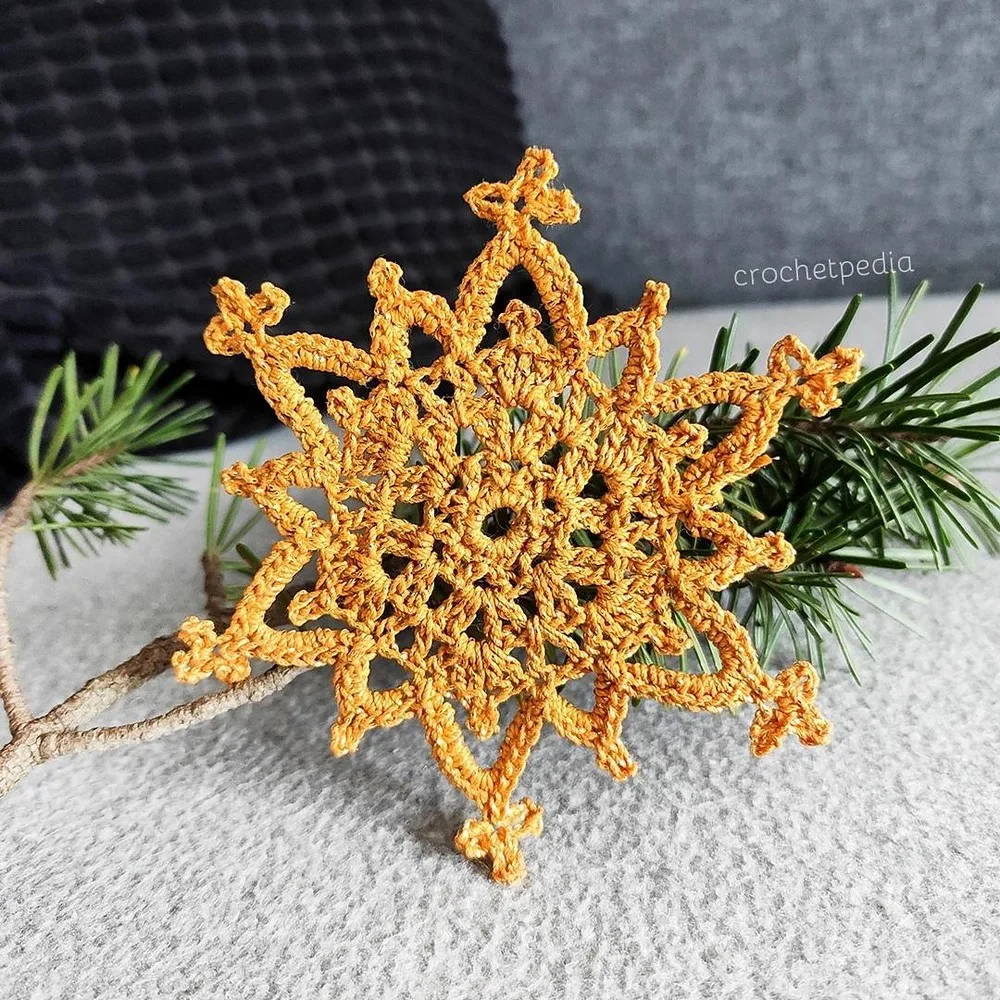
A small six-point snowflake worked in fine cotton thread with a 1.5 mm hook.
- Level
- Intermediate
- Time
- 1-2 hours
- Hook
- 1.5 mm
- Yarn
- Thread
Pattern highlights
- Chain a small ring and close it with a slip stitch to start the motif.
- Work a tidy circle of single crochet into that ring, then slip stitch to close.
- Build round two's chain spaces with paired double crochet stitches, repeated to shape six points.
- Round three works into each chain space, adding more double crochet and chain arches.
- Keep working outward through the remaining rounds, each one opening the points further.
- Close every round with a slip stitch before starting the next one.
About This Pattern
I keep a running list of small motifs, and this one earns its spot. A six-point lace star, worked in fine cotton thread, sits with the doilies and snowflakes I've collected. It's the kind of piece that takes an evening, not a weekend. I like that it asks for patience rather than yardage. Size aside, it holds its own next to anything bigger on the shelf.
The construction moves through six short rounds. A chain loop starts things off, then a ring of single crochet settles the base. Round two introduces chain-2 spaces between paired double crochet stitches, repeated five times to open the lace. Each later round works into those spaces, building the points outward one layer at a time. Every round closes with its own slip stitch, which keeps the whole motif honest and symmetrical.
What comes off the hook is small, flat, and six-pointed. It sits well on its own or alongside a cluster of its siblings. The open chain spaces catch light in a way a solid stitch never could. I wouldn't call it quick, not at 1.5 mm, but it's compact enough to finish in one sitting. A single star says little. A handful says more.
Worth knowing
There's something satisfying about watching a ring of single crochet turn into a six-point lace star. It happens in just six rounds. The chain-2 spaces in round two do the real work, repeated five times until the shape declares itself. Each slip stitch join is a small checkpoint, confirming the round sits even before moving on. Working at 1.5 mm with cotton thread slows my hands down in a good way. Nothing about this motif is complicated. It's the scale and the lace spaces that make it interesting, not the stitch vocabulary. By round three, the points are already visible, and that's the moment I enjoy most.
Common mistakes
- Losing count in the chain-2 spaces Count each chain space before moving on, since round two's symmetry depends on five even repeats.
- Pulling slip stitch joins too tight Keep the join loose enough to match the surrounding stitches, or the round edge will pucker.
- Working into the wrong loop at round Check each single crochet lands in the starting ring, not in a skipped stitch from the chain.
- Using a hook too large for the thread Stick with a 1.5 mm hook for cotton thread, since a bigger hook loosens the lace.
- Skipping the turning chain's second stitch Close round two into the second chain of the turning chain, or the point count shifts.


Intermediate
Progress Tracker
0 of 0 rounds
Tap a round to tick it off — your place is saved on this device.
The kit
Yarn
- 100% cotton thread (e.g., Scheepjes Maxi Sugar Rush)
- Crochet Hook: 1.5 mm
- Scissors
Start
Chain 6, form a loop and close it with a slip stitch.
Round 1Work 12 sc into the loop, close with a sl st.
Round 2Chain 4, 1 dc in the same stitch, skip 1 st, 1 dc, 2 ch, 1 dc in the same st, skip 1 st repeat 5 times, close with a sl st into the 2nd chain stitch of the turning chain.
Round 3Slip stitch in the chain space, chain 3, 1 dc in the chain space, 2 ch, 2 dc in the same loop, 2 dc, 2 ch, 2 dc in one chain space repeat 5 times, close with a sl st.
Round 42 sl st (into dc of the previous row), 1 sl st into the chain space, 3 ch, 2 dc in the loop, 1 picot, 2 dc in the same loop, 1 dc, 1 ch, 1 dc all in the smaller chain space, 3 dc into the loop, 1 picot on the 3rd dc, 2 dc, 1 dc, 1 ch, 1 dc all in the smaller chain space, repeat 5 times, close with a sl st.
Round 5Chain 12, sl st between the 5th dc of the first loop and the 1st dc of the second loop, chain 6, sl st between the 2nd dc of the first loop and the 1st dc of the third loop repeat 5 times.
Round 67 sc into the big loop, 2 ch, 3 picots all in the 2nd ch stitch, 1 sl st in the first ch st, 6 sc into the loop, 1 sl st in the same space as the sl st from the previous row, 4 sc into the small loop, 1 picot, 3 sc into the loop, 1 sl st in the same space repeat 5 times, close with a sl st.
Finishing
- Fasten off and weave every loose end along the back of the chain spaces so nothing shows on the front.
- Dampen the piece and pin each of the six points before it dries, to flatten the lace.
- Leave it pinned until fully dry, then lift it carefully off the blocking surface.
Why it works
Round one's ring of single crochet gives every later round the same anchor points to build from.
The paired double crochet stitches in round two repeat five times, creating six chain-2 spaces. Those spaces become the star's points.
Each round closes with its own slip stitch, letting me check symmetry before the next round begins.
What it becomes
- Pin it to a lapel as a small lace brooch.
- Stitch it onto the corner of a handkerchief or table linen.
- Hang it in a window on a thread, where the light shows the open chain spaces.
Original pattern: https://crocheteverything.com/crochet-frosty-star-snowflake-pattern/
FAQ
Can I use a different thread weight?
Yes, but the finished star changes size with the thread. Match the hook to the thread weight you choose.
Why does round two use chain-2 spaces instead of plain stitches?
The chain spaces open up the lace and give round three somewhere to work into. They are what shapes the points.
Does the motif need stiffening to hold its shape?
Thread crochet like this often benefits from light starching or blocking. It is not required, but it keeps the points crisp.
How many points does the finished star have?
Round two repeats five times after the first segment, giving six points in total. That is the structure that shapes every later round.