Free Pattern
Step-by-Step
Crochet
ClothingTapestry crochet cow print lounge pants in lavender
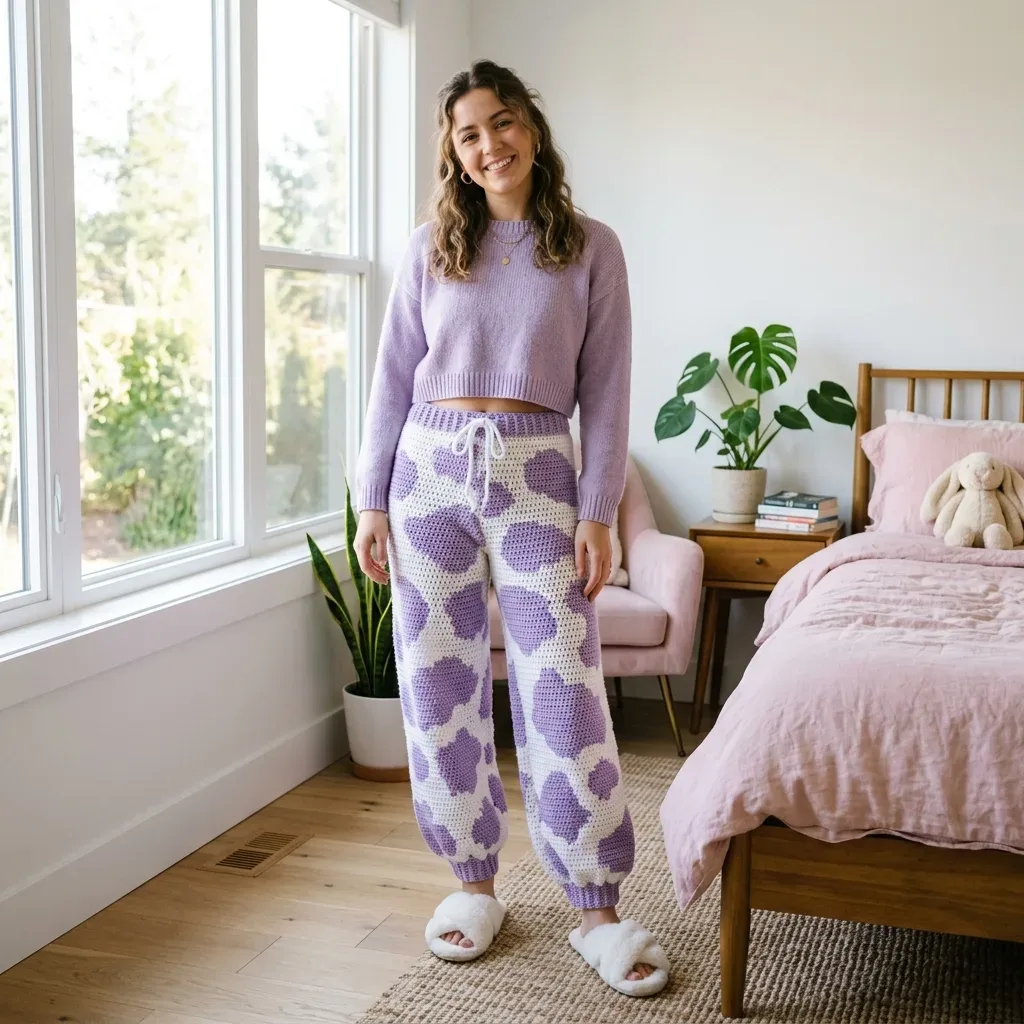
A tapestry crochet lounge pants pattern with irregular cow print spots in lavender and cream.
- Level
- Advanced
- Time
- 60-90 hours
- Hook
- 6.0 mm
- Yarn
- Worsted
Pattern highlights
- Start with the ribbed waistband, worked flat in slip stitch rows, then seam the short ends into a tube.
- Add the crotch bridge chain where the pattern tells you, joining the back and front halves into one leg.
- Repeat the whole leg setup a second time so both legs match in spot placement and length.
- Seam the legs together, weave in every color-change end, then thread the drawstring through the waistband channel.
- Finish by steam blocking the pants flat, taking care not to stretch the fabric while it's still damp.
About This Pattern
Lounge pants earn a different shelf in my collection than a hat or a toy. This cow print pair sits with the big, slow projects. I start them in one season and finish in the next. Sixty to ninety hours is not a casual estimate. It is a commitment, and I respect a pattern honest enough to say so upfront.
What comes out the other end is a genuinely unique garment. The cow spots are irregular and refuse to repeat exactly. There's a drawstring waist and ribbed cuffs that hug the ankle. The fit runs from Small/Medium up through 2X/3X. Yardage and stitch counts scale for each size. Nobody else will own this exact pair, cow spots included. It's loungewear, but it's also a conversation piece.
Common mistakes
- Floats peeking through stitches Lay the carried color flat across the top of the previous round before you insert your hook. If it sags loose, it will poke through to the front.
- Swatching in regular sc Carrying a second strand changes your gauge, so swatch in actual tapestry sc. A swatch measured in plain sc runs too loose.
- Spots that look too geometric Resist rounding every spot into a circle. The cow-like look comes from deliberately uneven, irregular edges.
- Stretching the ribbing while blocking Steam lightly and let the fabric rest flat. Pulling on wet ribbing at the waist or cuffs stretches it out of shape permanently.
Advanced
Progress Tracker
0 of 0 rounds
Tap a round to tick it off — your place is saved on this device.
The kit
- Lion Brand Pound of Love works beautifully for this project. It is soft against skin, machine washable, and comes in both off-white (Fisherman) and a lovely lilac. For Small/Medium, you need 1 skein of each color. Larger sizes need 2 skeins of each.
- Paintbox Yarns Simply DK held double gives you a lofty, cushioned fabric with excellent stitch definition. Use Soft White and Dusty Violet. You will need approximately 7 balls of each color for Small/Medium.
- WeCrochet Comfy Worsted (75% pima cotton, 25% acrylic) creates breathable pants with beautiful drape. Colors to use: Bare (cream) and Wisteria (lavender). You need 5 skeins of each color for Small/Medium, 6 for larger sizes.
- Avoid 100% cotton without any acrylic or nylon content. Pure cotton stretches out significantly at the waist and seat. Stick with acrylic or acrylic blends for shape retention and easy washing.
Yarn
- Yarn A (Cream/Off-White): Worsted weight, approximately 900 (1050, 1200) yards / 823 (960, 1097) meters
- Yarn B (Lavender/Medium Purple): Worsted weight, approximately 700 (850, 1000) yards / 640 (777, 914) meters
Hooks
- US Size J / 6.0 mm hook for the main body and legs
- US Size I / 5.5 mm hook for the ribbed waistband and ankle cuffs
Notions
- At least 6 stitch markers
- 2 tapestry needles for weaving ends and seaming
- Scissors
- 1 yard / 1 meter of white or cream cotton cord or 3/8 inch / 1 cm wide ribbon for the drawstring
- Optional: 1 inch / 2.5 cm wide non-roll elastic, 28 to 44 inches depending on size, for waistband reinforcement
Waistband Ribbing
The waistband and ankle cuffs use a back loop only slip stitch rib, worked flat and then seamed into a ring. Chain a multiple of 2 plus 1 for the turning chain before beginning Row 1.
Row 1Slip stitch in 2nd chain from hook and in each chain across. Turn. (14 sl sts)
Row 2Chain 1, slip stitch BLO in each stitch across. Turn. (14 sl sts) Repeat Row 2 until the ribbing measures: S/M: 30 inches / 76 cm (approximately 90 rows)L/XL: 34 inches / 86 cm (approximately 102 rows)2X/3X: 38 inches / 97 cm (approximately 114 rows)Work at relaxed tension so the ribbing can stretch over the hips.Do not fasten off. Fold the ribbing so the two short ends meet. Slip stitch the first and last rows together through both layers, leaving the top 2 inches / 5 cm open for the drawstring channel. Fasten off. Weave in ends.
Position the seam at center back.
Checkpoint: Your waistband ring should measure approximately 30 (34, 38) inches / 76 (86, 97) cm in circumference when lightly stretched, and 3.5 inches / 9 cm tall.
Right Leg Setup
Round 39Starting at the center back marker, Tsc in next 30 (34, 38) sts (right back half). Chain 6 (6, 8) for the crotch bridge. Skip the center front 60 (68, 76) sts. Tsc in the remaining 30 (34, 38) sts (right front half). Join to the first stitch. Turn.
You now have 60 (68, 76) sts plus 6 (6, 8) chain bridge = 66 (74, 84) working stitches for the right leg.
Round 40Tsc in each of the 60 (68, 76) body stitches, then Tsc in each of the 6 (6, 8) chains of the crotch bridge. Join. Turn. (66, 74, 84 sts)
Left Leg Setup
Round 41Join yarn at the center front marker with both colors ready. Working into the remaining 60 (68, 76) stitches, Tsc across. Then Tsc into the underside of the crotch bridge chains (6, 6, or 8 sts). Join. Turn. (66, 74, 84 sts)
Assembly
Step 1Thread your cotton cord or ribbon through the drawstring channel at the top of the waistband. Weave in all remaining ends securely. If desired, sew non-roll elastic inside the waistband for extra security.
Step 2Block your finished pants by laying them flat and steaming lightly. Avoid stretching the fabric while wet.
Finishing
- Fold the ribbing and slip stitch the short ends together, leaving the top open for the channel.
- Weave in every end from each color change before you block; tapestry crochet leaves plenty.
- Thread the cotton cord through the channel, then steam block the pants flat without stretching the damp fabric.
Why it works
Rnd 39's crotch bridge chain skips the center front stitches, opening the inseam.
The waistband and cuffs are worked flat in turned rows, then seamed into a tube afterward.
The right and left leg setups both start from the center back marker, placing the final seam there.
Gauge: using the J / 6.0 mm hook with worsted weight yarn in tapestry single crochet, 16 stitches = 4 inches / 10 cm and 18 rows/rounds = 4 inches / 10 cm. Measure your gauge in tapestry sc, not regular sc, since carrying a second strand changes your tension. Swatch at least 5 inches / 13 cm square, and wash and dry it before measuring — even half a stitch difference per inch will throw off your fit when working with roughly 120 stitches around.
Finished sizes: Small/Medium — waist 28 to 32 inches / 71 to 81 cm (relaxed), hips 38 to 42 inches / 97 to 107 cm, 27 inch / 69 cm inseam, 12 inch / 30 cm total rise, leg at widest 22 inches / 56 cm, ankle cuff 12 inches / 30 cm. Large/XL — waist 34 to 38 inches / 86 to 97 cm, hips 44 to 48 inches / 112 to 122 cm, 27 inch / 69 cm inseam, 13 inch / 33 cm total rise, leg at widest 24 inches / 61 cm, ankle cuff 13 inches / 33 cm. 2X/3X — waist 40 to 44 inches / 102 to 112 cm, hips 50 to 54 inches / 127 to 137 cm, 27 to 28 inch / 69 to 71 cm inseam, 14 inch / 36 cm total rise, leg at widest 26 inches / 66 cm, ankle cuff 14 inches / 36 cm.
Pattern notes: work the pants body in joined rounds, not spiral — slip stitch to the first stitch to join, chain 1, and turn at the end of each round. Turning at each join is optional but recommended since it creates a neater join and makes colorwork easier to track. The cow print spots are irregular and asymmetrical, so follow the stitch-by-stitch color sequences carefully; both colors are carried throughout the entire garment, even through solid sections. The waistband is worked flat first, seamed into a ring, then you pick up stitches along one edge to begin the body. All stitch counts are given as S/M (L/XL, 2X/3X). Weave in ends as you go; most color changes encase ends automatically with tapestry crochet, but loose tails still need attention.
What it becomes
- Wear them as loungewear; the dense tapestry fabric holds its shape through a full day on the couch.
- Travel in them; worsted acrylic yarn machine washes easily after a long flight.
- Pair them with a plain fitted tee so the cow print spots stay the focal point.
FAQ
Can I make these in a different colorway besides lavender and cream?
Yes, the construction doesn't depend on the colors. Pick any two shades with enough contrast so the spots read clearly.
Why does the pattern insist on acrylic or acrylic-blend yarn?
Pure cotton stretches out at the waist and seat with wear. Acrylic and acrylic blends hold their shape through washing and sitting.
Is tapestry single crochet much harder than regular single crochet?
It adds one extra step: encasing the carried color inside each stitch. Once your hands learn the rhythm, it moves at close to the same pace as regular sc.
How do I know my gauge is right before starting the legs?
Swatch in tapestry sc, not plain sc, since carrying two strands tightens your tension. Check your stitch and row count against the gauge before committing all that yardage.